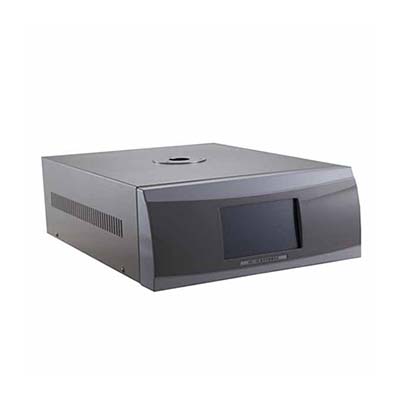
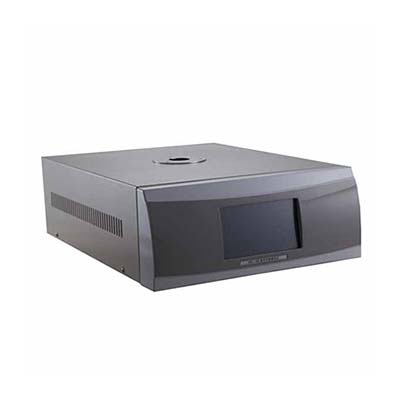
DSC-200 Cooling Scan Differential Scanning Calorimeter
- PRODUCT DETAIL
DSC-200 Cooling Scan Differential Scanning Calorimeter
Product Introduction
The
DSC-200 Differential Scanning Calorimeter is a high-performance thermal
analysis instrument designed to measure the relationship between temperature
and heat flow during material transitions. It supports both heating and cooling
scans, making it suitable for comprehensive thermal characterization in
material research, product development, performance evaluation, and quality
control.
The
instrument can analyze various thermal properties and transitions, including
glass transition temperature, cold crystallization, phase transitions, melting,
crystallization, thermal stability, curing, crosslinking, and oxidation
induction behavior.
Featuring
a newly designed furnace structure, precise gas mass flow control, and
automated temperature regulation, the DSC-200 delivers improved resolution,
stable baselines, and reliable measurement performance. Its 7-inch color
touchscreen, USB data interface, and dual control modes provide convenient
operation for laboratory thermal analysis.
Performance Features
1.Advanced Furnace
Structure: The newly designed furnace improves
measurement resolution
and baseline stability, supporting accurate thermal
analysis.
2. Precise Gas Flow
Control: An integrated gas mass flow meter accurately regulates purge gas flow,
with flow data recorded directly in the database.
3. Dual Control Modes:
Supports both main-unit control and computer software control, offering
flexible operation and convenient instrument management.
4. Heating and Cooling
Scans: Performs both heating and cooling temperature scans to characterize
material thermal transitions comprehensively.
5. Automatic
Temperature Regulation: Integrates temperature control, constant-temperature
operation, and cooling with automatic process control.
6. High Measurement
Sensitivity: Provides DSC noise and resolution of 0.01 μW, supporting the
detection of small thermal effects.
7.
Intuitive Touchscreen Operation: Equipped with a 7-inch, 24-bit color LCD
touchscreen for convenient parameter setting and result viewing.
8. Automatic Atmosphere
Switching: Automatically switches the instrument atmosphere according to test
requirements.
9. Convenient Data Connectivity: Standard USB
interface supports data transfer and external connectivity.
10. One-Key
Calibration: Supplied standard materials and one-key calibration functionality
allow users to perform temperature and enthalpy self-calibration.
Working Principle
The
DSC-200 operates based on the principle of Differential Scanning Calorimetry
(DSC). During a controlled heating or cooling program, it measures the
difference in heat flow between a sample and a reference under the same
temperature conditions.
When
a material undergoes thermal transitions, such as melting, crystallization,
glass transition, or curing, its heat absorption or release changes. The
instrument detects these thermal effects and generates a DSC curve showing heat
flow as a function of temperature or time.
By
analyzing the resulting curve, users can determine characteristic thermal
parameters, including transition temperatures, melting and crystallization
behavior, curing characteristics, and oxidation induction properties. Both
heating and cooling scans provide a more complete understanding of material
thermal behavior.
Technical Parameters
Parameter
Specification
Model
DSC-200
Instrument
Type
Differential
Scanning Calorimeter
DSC
Measurement Range
0
to ±500 mW
Temperature
Range
Room
Temperature to 600°C (with cooling capability)
Heating
Rate
1–80°C/min
Cooling
Rate
1–10°C/min
Temperature
Resolution
0.1°C
Temperature
Fluctuation
±0.1°C
Temperature
Repeatability
±0.1°C
DSC
Noise
0.01
μW
DSC
Resolution
0.01
μW
DSC
Accuracy
0.1
μW
DSC
Sensitivity
0.1
μW
Temperature
Control
Heating,
constant temperature, and cooling
Curve
Scanning
Heating
scan and cooling scan
Atmosphere
Control
Automatic
atmosphere switching
Display
7-inch,
24-bit color LCD touchscreen
Data
Interface
Standard
USB
Calibration
Standard
reference materials with one-key temperature and enthalpy calibration
Application Scenarios
• Polymer
Research: Determine glass transition temperature, melting point,
crystallization
behavior, and cold crystallization characteristics of polymers.
• Plastics
and Rubber Industry: Evaluate curing, crosslinking, and thermal stability to
support material formulation and processing optimization.
• Pharmaceutical
Industry: Investigate thermal transitions, crystallization behavior, and
physical stability of pharmaceutical materials.
• Chemical Industry:
Analyze phase transitions, reaction behavior, and thermal properties of
chemical compounds.
• New
Materials Development: Characterize thermal properties of advanced materials
during research and product development.
• Quality Control:
Monitor material consistency and verify thermal performance across production
batches.
• Research and Academic
Laboratories: Support thermal analysis experiments, material characterization,
and scientific education.
DSC-200 vs. Conventional Differential Scanning Calorimeters
Comparison Factor
DSC-200
Conventional DSC Instruments
Scanning
Modes
Heating
and cooling scans
Depends
on model
Furnace
Design
Newly
designed furnace structure
Varies
by configuration
Baseline
Stability
Improved
baseline stability
Depends
on instrument design
Gas
Flow Control
Integrated
mass flow meter
Depends
on configuration
Temperature
Control
Automatic
heating, holding, and cooling
Depends
on control system
DSC
Noise
0.01
μW
Model-dependent
DSC
Resolution
0.01
μW
Model-dependent
Operation
7-inch
color touchscreen and software control
Varies
by interface
Calibration
One-key
temperature and enthalpy calibration
Depends
on calibration system
Frequently Asked Questions (FAQ)
1. What is the DSC-200 Differential Scanning Calorimeter
used for?
The
DSC-200 is used to measure heat flow changes associated with material thermal
transitions, including glass transition, melting, crystallization, phase
transitions, curing, and thermal stability.
2. What is the temperature range of the DSC-200?
The
instrument supports a temperature range from room temperature to 600°C, with
cooling capability.
3. Does the DSC-200 support both heating and cooling scans?
Yes.
It supports both heating and cooling temperature scans, allowing users to
investigate thermal transitions and crystallization behavior under different
temperature conditions.
4. What is the heating and cooling rate?
The
heating rate ranges from 1 to 80°C/min, while the cooling rate ranges from 1 to
10°C/min.
5. What thermal properties can the DSC-200 measure?
It
can characterize glass transition temperature, cold crystallization, melting,
crystallization, phase transitions, thermal stability, curing, crosslinking,
and oxidation induction behavior.
6. How does the instrument control purge gas flow?
The
DSC-200 incorporates a gas mass flow meter for precise purge gas flow
regulation. Flow data can be recorded directly in the instrument database.
7. What is the measurement sensitivity of the DSC-200?
The
specified DSC sensitivity is 0.1 μW, with a noise level and resolution of 0.01
μW.
8. How is the DSC-200 calibrated?
The
instrument is supplied with standard reference materials and supports one-key
calibration, allowing users to perform temperature and enthalpy
self-calibration.
9. Is the DSC-200 suitable for quality control and research
laboratories?
Yes.
Its precise thermal control, heating and cooling scan capabilities, stable
baseline performance, and convenient touchscreen operation make it suitable for
both research and routine material quality testing.