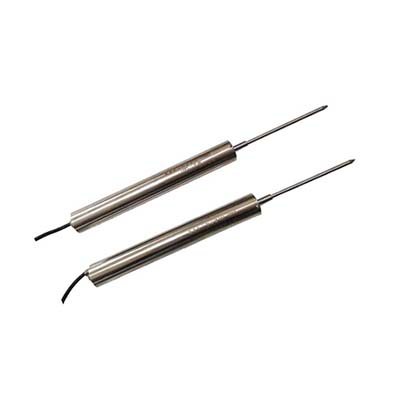
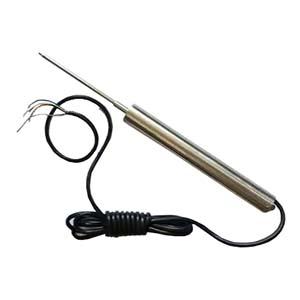
DMWY Full-Bridge Strain Displacement Sensor
- PRODUCT DETAIL
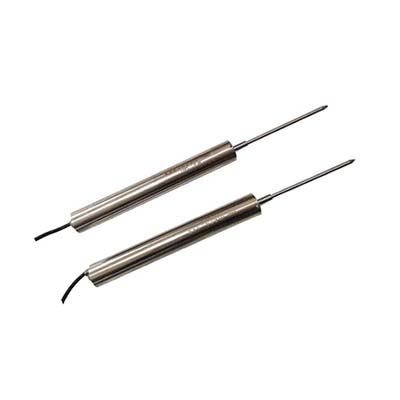
DMWY Full-Bridge Strain Displacement Sensor
Product Introduction
The
DMWY Full-Bridge Strain Displacement Sensor is designed to measure linear
displacement and displacement-related mechanical changes in structural and
engineering applications. It converts mechanical displacement into electrical
signals through a full-bridge strain gauge circuit, allowing measurement data
to be collected and analyzed using compatible static or dynamic strain
acquisition systems.
With
multiple measurement ranges, a compact structure, and customizable dimensions,
the DMWY sensor is suitable for static, quasi-static, and low-frequency dynamic
displacement measurements. It is widely used in civil engineering, bridge and
tunnel monitoring, hydropower projects, material mechanics testing, aviation
research, and other scientific and industrial applications.
Performance Features
• Full-Bridge
Strain Gauge Design: Uses a 350 Ω full-bridge circuit for
displacement signal conversion.
• Multiple Measurement
Ranges: Available in ranges from 5 mm to 200 mm to accommodate different testing
requirements.
• High Measurement
Accuracy: Accuracy of ≤0.3% F.S.
• Static and Dynamic
Measurement: Suitable for static, quasi-static, and low-frequency
dynamic displacement testing.
• Flexible Installation: Supports
bottom or side cable outlets.
• Customizable
Dimensions: Sensor dimensions can be customized according to project
requirements.
• Long
Service Life: The theoretical service life is up to 10 million cycles,
depending on actual test conditions.
• System
Compatibility: Can be used with dynamic and static strain data
acquisition systems, cables, and related equipment.
Working Principle
The
DMWY sensor operates based on the strain gauge measurement principle. When the
measured object undergoes linear displacement, the sensor's internal elastic
structure deforms, causing a change in the resistance of the strain gauges.
The
full-bridge circuit converts this resistance change into an electrical signal
proportional to the applied displacement. The output signal is then transmitted
to a compatible static or dynamic strain acquisition instrument for
measurement, recording, and analysis.
Technical Parameters
Parameter
Specification
Outer
diameter
28
mm
Fixed
shaft diameter
8
mm
Measurement
ranges
5,
10, 20, 30, 50, 100, 200 mm
Accuracy
≤0.3%
F.S.
Bridge
resistance
350
Ω, full bridge
Supply
voltage
2
V
Full-scale
output
Approximately
10,000 με
Operating
temperature
-35
to +80°C
Measurement
characteristics
Static
measurement supported
Wiring
method
Red
(A), Green (B), White (C), Black (D)
Cable
outlet
Bottom
or side outlet
Theoretical
service life
10
million cycles, depending on actual test conditions
Compatible
equipment
Dynamic
and static strain acquisition systems, cables, and accessories
Customization
Dimensions
can be customized
Application Scenarios
The
DMWY full-bridge strain displacement sensor is suitable for:
• Civil
Engineering: Structural displacement and deformation monitoring in
engineering projects.
• Bridge Monitoring: Measurement
of displacement and structural response in bridge components.
• Tunnel
Engineering: Monitoring of displacement and deformation in tunnel
structures.
• Hydropower
Projects: Displacement testing of hydraulic and hydropower structures.
• Material Mechanics: Linear
displacement measurement during material and mechanical testing.
• Aviation
Research: Displacement testing in aviation-related research and development.
• Scientific Research and
Production: Static, quasi-static, and low-frequency dynamic
displacement experiments.
Product Comparison
Feature
DMWY Full-Bridge Sensor
Conventional Strain-Type Displacement Sensor
Bridge
configuration
Full
bridge
Depends
on model
Bridge
resistance
350
Ω
Model-dependent
Measurement
ranges
5–200
mm
Model-dependent
Accuracy
≤0.3%
F.S.
Model-dependent
Measurement
modes
Static,
quasi-static, low-frequency dynamic
Depends
on model
Cable
outlet
Bottom
or side
Depends
on design
Customization
Available
Depends
on manufacturer
Frequently Asked Questions (FAQ)
1. What is the DMWY full-bridge strain displacement sensor
used for?
It
is used to measure linear displacement and displacement-related deformation in
civil engineering, bridge and tunnel monitoring, hydropower, material
mechanics, and scientific research.
2. What measurement ranges are available?
The
standard measurement ranges are 5, 10, 20, 30, 50, 100, and 200 mm.
3. What is the measurement accuracy of the DMWY sensor?
The
specified accuracy is ≤0.3% F.S., where F.S. refers to full scale.
4. Does the sensor support static and dynamic measurements?
Yes.
It can be used for static, quasi-static, and low-frequency dynamic displacement
measurements when connected to a compatible strain acquisition system.
5. What type of bridge circuit does this sensor use?
The
DMWY sensor uses a 350 Ω full-bridge strain gauge circuit.
6. What is the full-scale output of the sensor?
The
approximate full-scale output is 10,000 microstrain (με).
7. How is the DMWY sensor connected?
The
four-wire connections are red (A), green (B), white (C), and black (D). It
should be connected according to the corresponding terminals of the acquisition
instrument.
8. Can the sensor dimensions be customized?
Yes.
The sensor dimensions can be customized to meet specific installation and
measurement requirements.
9. What is the theoretical service life of the sensor?
The
theoretical service life is approximately 10 million cycles. Actual service
life depends on the operating environment, displacement conditions, and testing
frequency.