ECG-11D Digital Single Channel Electrocardiograph
Product Introduction
The
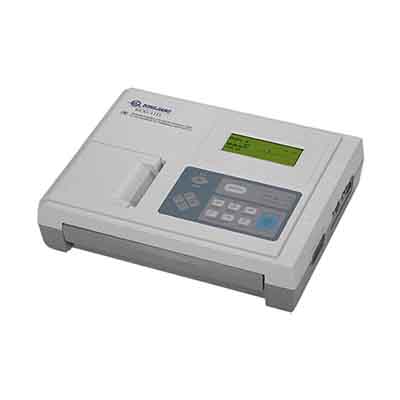
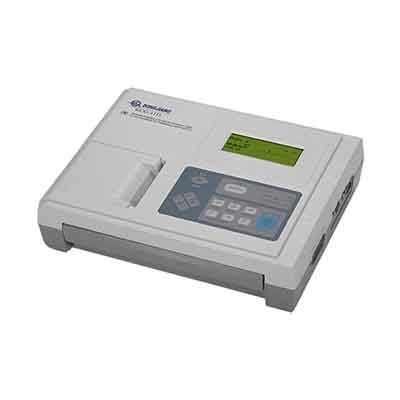
ECG-11D Digital Single Channel Electrocardiograph is a medical ECG recording
device designed for acquiring, displaying, and recording electrocardiographic
signals. It supports standard or Cabrera 12-lead configurations and offers
multiple automatic and manual operating modes to meet different ECG examination
requirements.
Equipped
with an isolated input circuit, defibrillation and pacemaker protection, a
graphic LCD, and a thermal array printer, the ECG-11D provides reliable ECG
waveform acquisition and recording. Its automatic baseline control, multiple
filter functions, and rechargeable battery make it suitable for routine ECG
examinations in hospitals, clinics, and other medical settings.
Performance Features
• 12-Lead
ECG Acquisition: Supports standard and Cabrera 12-lead configurations.
• Multiple Operating
Modes: Includes four automatic modes (AUTO1–AUTO4) and manual lead switching.
• Digital
Signal Processing: Features 12-bit A/D conversion and a 1 ms
sampling interval.
• High-Quality
Signal Acquisition: CMRR greater than 100 dB, input impedance
greater than 50 MΩ, and noise level below 15 μVp-p.
• Patient
Safety Protection: Isolated input circuit with defibrillation and
pacemaker protection.
• Clear
Waveform Display: 2-inch, 192 × 64 graphic LCD displays ECG
waveforms, heart rate, and operating status.
• Automatic
Baseline Control: Includes automatic baseline adjustment and
baseline drift suppression.
• Thermal Array Printing: Integrated
thermal printer supports 25 mm/s and 50 mm/s paper speeds.
• Rechargeable Battery: Built-in
14.4 V, 1.2 Ah sealed rechargeable battery supports battery-powered operation.
• Flexible
ECG Recording: Supports rhythm lead recording and automatic adjustment of
lead duration in AUTO1–AUTO3 modes.
Working Principle
The
ECG-11D electrocardiograph detects the electrical potentials generated by the
heart through electrodes attached to the patient's body. These weak bioelectric
signals are transmitted through the patient cable to the instrument's isolated
input circuit.
After
amplification, filtering, and signal conditioning, the ECG signals are
converted into digital data through a 12-bit analog-to-digital converter. The
instrument processes the acquired signals and displays the ECG waveforms and
heart rate on its LCD.
The
processed ECG data can then be recorded using the built-in thermal array
printer. Users can select automatic or manual operating modes, configure lead
settings, and adjust recording parameters according to examination
requirements.
Technical Parameters
|
Parameter
|
Specification
|
|
Model
|
ECG-11D
|
|
Product
type
|
Digital
single channel electrocardiograph
|
|
Lead
configuration
|
Standard
or Cabrera 12 leads
|
|
Display
|
2-inch,
192 × 64 graphic LCD
|
|
Display
information
|
Operating
status, heart rate, ECG waveform
|
|
Sampling
interval
|
1
ms
|
|
A/D
conversion
|
12
bit
|
|
Calibration
voltage
|
1
mV ±5%
|
|
Input
circuit
|
Isolated
input circuit
|
|
Defibrillation
protection
|
Yes
|
|
Pacemaker
protection
|
Yes
|
|
CMRR
|
>100
dB
|
|
Input
impedance
|
>50
MΩ
|
|
Input
circuit current
|
≤50
nA
|
|
Patient
leakage current
|
<10
μA
|
|
Time
constant
|
≥3.2
s
|
|
Frequency
response
|
0.05–150
Hz
|
|
Noise
level
|
<15
μVp-p
|
|
Threshold
|
≤20
μV
|
|
Sensitivity
|
5,
10, 20 mm/mV
|
|
Skin
voltage tolerance
|
±400
mV
|
|
Baseline
control
|
Automatic
baseline control and baseline drift suppression
|
|
Filters
|
AC
50 Hz (-20 dB); EMG 35 Hz (-3 dB)
|
|
Operating
modes
|
AUTO1,
AUTO2, AUTO3, AUTO4, MAN
|
|
AUTO1
|
Standard
automatic single channel
|
|
AUTO2
|
European
automatic single channel
|
|
AUTO3
|
Simulated
three-channel mode
|
|
AUTO4
|
Rhythm
lead + standard lead
|
|
MAN
|
Manual
lead switching
|
|
Lead
duration
|
Automatic
lead duration adjustment in AUTO1–AUTO3
|
|
Printer
|
Thermal
array printer
|
|
Printer
resolution
|
8
dots/mm vertical; 40 dots/mm horizontal at 25 mm/s
|
|
Paper
type
|
Roll
paper, 50 mm × 20 m (30 m)
|
|
Paper
speed
|
25,
50 mm/s
|
|
Printout
information
|
Sensitivity,
paper speed, filter operation, time, heart rate, lead mark
|
|
Patient
cable
|
DJ
ECG-A.F01.001A
|
|
Battery
|
Sealed
rechargeable battery, 14.4 V, 1.2 Ah
|
|
Power
requirements
|
AC
220 V (110 V), 50–60 Hz, 30 VA
|
|
Safety
classification
|
Class
I, Type CF
|
|
Dimensions
|
292
× 228 × 70 mm
|
|
Weight
|
3.3
kg
|
External Signal Output
|
Parameter
|
EXT
|
CRO
|
|
Output
type
|
Single-ended
|
Single-ended
|
|
Input
impedance
|
≥100
kΩ
|
Not
specified
|
|
Sensitivity
|
10
mm/mV ±5%
|
0.5
V/mV ±5%
|
|
Input
voltage
|
±2.5
V
|
Not
specified
|
|
Output
impedance
|
Not
specified
|
≤100
Ω
|
Environmental Conditions
|
Condition
|
Temperature
|
Relative Humidity
|
Atmospheric Pressure
|
|
Operation
|
+5°C
to +40°C
|
25%–80%
|
700–1060
hPa
|
|
Transportation
|
-40°C
to +55°C
|
25%–95%
|
700–1060
hPa
|
|
Storage
|
-10°C
to +40°C
|
25%–80%
|
700–1060
hPa
|
Fuse Specifications
|
Power Supply
|
Fuse Specification
|
|
AC
220 V
|
T125
mA / 250 V
|
|
AC
110 V
|
T250
mA / 250 V
|
|
DC
|
T2
A / 250 V, 5 × 20 mm
|
Application Scenarios
The
ECG-11D digital electrocardiograph is designed for routine ECG examination and
cardiac electrical activity recording in:
• Hospitals: ECG
waveform acquisition and recording in clinical departments.
• Clinics and Medical
Centers: Routine electrocardiographic examinations.
• Cardiology Departments: 12-lead ECG
recording for cardiac assessment.
• Physical
Examination Centers: ECG recording as part of general health
examinations.
• Emergency and Patient
Monitoring Settings: ECG signal acquisition where portable
recording equipment is required.
• Medical Education and
Research: ECG waveform demonstration, recording, and related research activities.
Product Comparison
|
Feature
|
ECG-11D Digital Single Channel ECG
|
Conventional ECG Recorder
|
|
Lead
configuration
|
Standard
or Cabrera 12 leads
|
Depends
on model
|
|
Operating
modes
|
Five
modes, AUTO1–AUTO4 and MAN
|
Model-dependent
|
|
Signal
conversion
|
12-bit
A/D
|
Model-dependent
|
|
Display
|
Graphic
LCD
|
Model-dependent
|
|
Printing
|
Built-in
thermal array printer
|
Depends
on configuration
|
|
Baseline
control
|
Automatic
control and drift suppression
|
Model-dependent
|
|
Power
supply
|
AC
and rechargeable battery
|
Model-dependent
|
|
Defibrillation
protection
|
Supported
|
Depends
on model
|
Frequently Asked Questions (FAQ)
1. What is the ECG-11D digital electrocardiograph used for?
The
ECG-11D is used to acquire, display, and record electrocardiographic signals
for routine cardiac examinations in hospitals, clinics, and medical examination
centers.
2. Does the ECG-11D support 12-lead ECG recording?
Yes.
It supports both standard and Cabrera 12-lead configurations.
3. What automatic operating modes are available?
The
instrument provides four automatic modes: AUTO1 for standard automatic
single-channel recording, AUTO2 for European automatic single-channel
recording, AUTO3 for simulated three-channel operation, and AUTO4 for rhythm
lead plus standard lead recording.
4. Does the ECG-11D support manual operation?
Yes.
The MAN mode allows users to switch leads manually.
5. What is the sampling interval of the ECG-11D?
The
sampling interval is 1 ms, with 12-bit analog-to-digital conversion.
6. Does the ECG-11D have a built-in printer?
Yes.
It features an integrated thermal array printer with 50 mm roll paper and
selectable paper speeds of 25 mm/s and 50 mm/s.
7. Does the electrocardiograph support battery operation?
Yes.
It has a built-in sealed rechargeable battery rated at 14.4 V and 1.2 Ah, in
addition to AC power operation.
8. What safety protections are provided?
The
ECG-11D features an isolated input circuit and protection against
defibrillation and pacemaker-related signals. It is classified as Class I, Type
CF.
9. What are the dimensions and weight of the ECG-11D?
The
instrument measures 292 × 228 × 70 mm and weighs approximately 3.3 kg.