ZH-SMTA Laboratory Animal Sleep Deprivation Instrument
- PRODUCT DETAIL
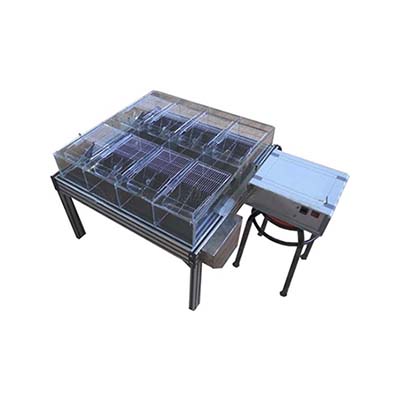
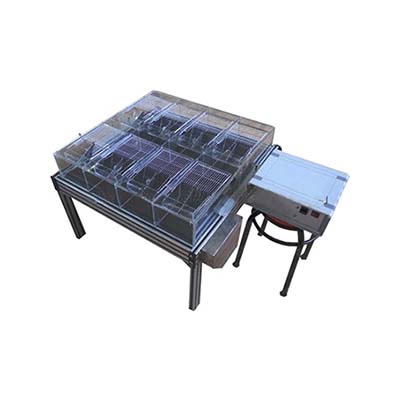
ZH-SMTA Laboratory Animal Sleep Deprivation Instrument
2. Adjustable Sound Stimulation: Set sound stimulation frequency according to research requirements.
4. Eight-Animal Capacity: Supports simultaneous experiments with up to eight mice or rats.
7. Automated Cycling: Running and resting periods can be programmed to repeat automatically.
|
Parameter |
Specification |
|
Model |
ZH-SMTA |
|
Product Type |
Laboratory Animal Sleep Deprivation Instrument |
|
Experimental Animals |
Mice and rats |
|
Maximum Capacity |
8 animals |
|
Operation Mode |
Touchscreen manual operation and English computer software |
|
Display |
Full-color TFT LCD |
|
Motor Type |
Imported servo motor |
|
Motor Response Time |
1 ms |
|
Motor Noise |
Less than 30 dB |
|
Speed Control Range |
0–100 m/min |
|
Speed Control Accuracy |
0.01 m/min |
|
Distance Measurement Accuracy |
Centimeter-level; stated error less than 0.1% |
|
Motion Control |
Closed-loop feedback |
|
Programmable Settings |
Forward/reverse rotation, acceleration, deceleration, and rest periods |
|
Sound Stimulation |
Adjustable frequency |
|
Data Storage |
Up to 50 sets of experimental data |
|
Data Output |
COM interface, computer transfer, and printing |
|
Animal Water Supply |
Supported |
|
Power Supply |
220 V AC, single-phase, 50 Hz |
|
Total Power |
200 W |
|
Instrument Weight |
Approximately 25 kg |
• Behavioral Studies: Evaluating behavioral changes associated with altered sleep patterns.
• Comparative Animal Experiments: Supporting controlled sleep-related studies in mice and rats.
ZH-SMTA vs. Traditional Sleep Deprivation Methods
|
Comparison Factor |
ZH-SMTA Instrument |
Traditional Water-Based Methods |
|
Sleep Deprivation Method |
Programmable rotating platform |
Water-based environmental stimulation |
|
Motion Control |
Adjustable speed and rotation direction |
Typically limited or method-dependent |
|
Experimental Protocols |
Freely programmable motion and rest cycles |
Often less flexible |
|
Sound Stimulation |
Adjustable frequency |
Depends on the experimental setup |
|
Animal Capacity |
Up to 8 animals per instrument |
Depends on apparatus design |
|
Data Management |
Automatic storage and computer transfer |
May require additional recording |
|
Long-Term Experiments |
Supports extended experimental modeling |
Depends on system design |
|
Electrical Stimulation |
Not required by the described operating principle |
Depends on the selected method |
Frequently Asked Questions (FAQ)
1. What is the ZH-SMTA Laboratory Animal Sleep Deprivation Instrument used for?
2. How many animals can the instrument accommodate?
The system supports up to eight mice or rats simultaneously.
3. How does the ZH-SMTA induce sleep deprivation?
4. Can researchers customize experimental protocols?
5. Is the running speed adjustable?
Yes. The specified speed control range is 0–100 m/min, with a stated control accuracy of 0.01 m/min.
6. Does the instrument support sound stimulation?
Yes. The frequency of sound stimulation can be adjusted according to experimental requirements.
7. Can the instrument be used for long-term experiments?
8. How are experimental data stored and exported?
9. What power supply does the ZH-SMTA require?
The instrument operates on 220 V single-phase AC at 50 Hz, with a total power consumption of 200 W.