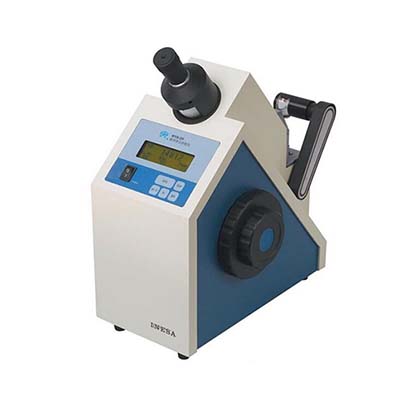
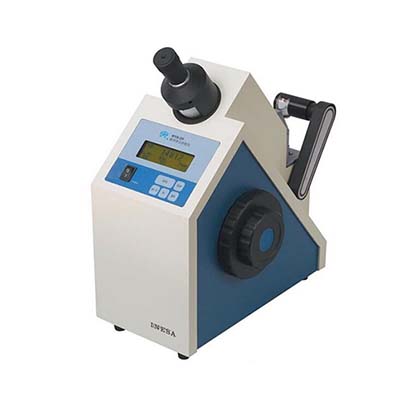
WYA-2S Digital Abbe Refractometer
- PRODUCT DETAIL
WYA-2S Digital Abbe Refractometer
Product Introduction
The
WYA-2S Digital Abbe Refractometer is a laboratory instrument designed to
measure the refractive index of liquids and solids, as well as the Brix value
of sugar solutions. Combining visual targeting with digital readings, it
provides convenient measurement and clear result presentation for routine
laboratory testing and quality control.
With
a refractive index measurement range of 1.3000–1.7000 and a Brix range of
0–95%, the WYA-2S supports a wide variety of analytical applications involving
sugar solutions, food ingredients, chemical liquids, and other suitable
materials. Its temperature display and temperature-correction capability for
Brix measurements help users account for temperature-related variations in
measurement results.
The
instrument also features a standard printer interface for direct data printing,
making it suitable for laboratories that require convenient result recording
and traceability.
Performance Features
1. Refractive Index
Measurement: Measures the refractive index (nD) of suitable liquid and
solid samples within a range of 1.3000–1.7000.
2. Brix Measurement: Measures sugar
solution concentration on the Brix scale from 0 to 95%, supporting routine
sugar concentration analysis.
3. Visual Targeting and
Digital Readings: Combines visual targeting with digital
measurement readings for convenient operation and result interpretation.
4. High-Resolution
Measurement: Provides a refractive index resolution of 0.0001 for
detailed sample comparison and laboratory analysis.
5. Brix Temperature
Correction: Supports temperature correction for Brix measurements to
improve result consistency under varying measurement conditions.
6. Temperature Display: Displays
temperature from 0°C to 50°C with a minimum indication of 0.1°C.
7. Standard Printer
Interface: Allows measurement data to be printed directly using a compatible printer,
supporting laboratory documentation.
8. Compact Laboratory
Design: With a weight of approximately 8 kg and dimensions of 330 × 180 × 380 mm, the
instrument can be accommodated on a laboratory workbench.
Working Principle
The
WYA-2S Digital Abbe Refractometer measures the refractive index of a sample by
analyzing how light changes direction when passing between materials with
different optical properties.
When
a suitable sample is placed on the measuring surface, the instrument uses the
optical boundary between the sample and the prism to determine its refractive
index. The result is expressed as (n_D), referring to refractive index measured
at the sodium D-line reference wavelength under specified conditions.
For
sugar solutions, the instrument can also display the Brix value, which
represents the concentration of dissolved sucrose in a solution under defined
measurement conditions. Temperature correction helps account for the effect of
temperature on Brix readings.
The
refractive index and Brix results can then be used for sample identification,
concentration assessment, process monitoring, and quality control, provided the
measurement method is appropriate for the sample being tested.
Technical Parameters
Parameter
Specification
Model
WYA-2S
Instrument
Type
Digital
Abbe Refractometer
Refractive
Index Measurement Range
1.3000–1.7000
nD
Brix
Measurement Range
0–95%
Brix
Minimum
Brix Scale Value
0.1
Refractive
Index Resolution
0.0001
nD
Refractive
Index Accuracy
≤
±0.0002
Brix
Accuracy
≤
±0.1%
Temperature
Display Range
0–50°C
Minimum
Temperature Indication
0.1°C
Measurement
Functions
Refractive
index and Brix
Display
and Reading Method
Visual
target with digital readings
Temperature
Compensation
Brix
temperature correction
Data
Output
Standard
printer interface
Weight
Approximately
8 kg
Dimensions
330
× 180 × 380 mm
Note: The supplied specifications do not state the
measurement wavelength beyond the nD designation, the exact
temperature-correction algorithm, or the compatible printer models. Confirm
these details with the manufacturer when required.
Application Scenarios
The
WYA-2S Digital Abbe Refractometer is suitable for laboratories and production
environments that require refractive index or Brix measurements.
• Food and Beverage
Industry: Brix measurement of sugar solutions, syrups, juices, and other suitable liquid
products.
• Sugar Processing: Monitoring
sugar solution concentration during preparation and processing.
• Chemical
Laboratories: Measuring the refractive index of compatible chemical
liquids and materials.
• Pharmaceutical
Laboratories: Testing the refractive index of suitable raw materials and
liquid preparations using validated methods.
• Quality
Control Departments: Comparing refractive index and Brix values
across production batches.
• Research
and Education: Teaching and experimental work involving refraction,
optical properties, and solution concentration.
• Industrial Production: Supporting
process monitoring where refractive index or Brix is an appropriate quality
indicator.
Comparison: WYA-2S Digital Abbe Refractometer vs.
Traditional Manual Refractometer
Feature
WYA-2S Digital Abbe Refractometer
Traditional Manual Refractometer
Reading
Method
Visual
target with digital readings
Typically
visual scale reading
Refractive
Index Range
1.3000–1.7000
Depends
on model
Refractive
Index Resolution
0.0001
Depends
on model and scale
Refractive
Index Accuracy
≤
±0.0002
Depends
on model
Brix
Range
0–95%
Depends
on model
Brix
Accuracy
≤
±0.1%
Depends
on model
Temperature
Display
0–50°C
Depends
on model
Brix
Temperature Correction
Supported
Depends
on model
Data
Printing
Standard
printer interface
Often
requires manual recording
Typical
Use
Laboratory
testing and documented quality control
Routine
measurements and field testing, depending on design
This comparison is based on general instrument
characteristics rather than testing against a specific competing model.
Frequently Asked
Questions
Q1: What does the WYA-2S Digital Abbe Refractometer
measure?
It
measures the refractive index of suitable liquid and solid samples and the Brix
value of sugar solutions.
Q2: What is the refractive index range of the WYA-2S?
The
specified refractive index range is 1.3000–1.7000 nD, with a resolution of
0.0001 and accuracy of ≤ ±0.0002.
Q3: What is the Brix measurement range?
The
instrument measures Brix values from 0 to 95%, with a minimum scale value of
0.1 and specified accuracy of ≤ ±0.1%.
Q4: Does the WYA-2S support temperature correction?
Yes.
It supports temperature correction for Brix measurements and displays
temperature over a range of 0–50°C, with a minimum indication of 0.1°C.
Q5: Can the instrument measure solid samples?
The
stated measurement capability includes the refractive index of liquids and
solids. Sample suitability depends on the sample's optical properties, surface
condition, and compatibility with the measuring prism.
Q6: Can measurement results be printed directly?
Yes.
The WYA-2S provides a standard printer interface for direct printing of
measurement data using a compatible printer.
Q7: Which industries can use the WYA-2S?
Typical
applications include food and beverage processing, sugar production, chemical
testing, pharmaceutical laboratories, education, research, and industrial
quality control.
Q8: What is the difference between refractive index and
Brix?
Refractive
index describes how light propagates through a material. Brix is a
concentration scale commonly used for sucrose solutions. Although refractive
index can be used to estimate Brix, other dissolved substances may affect the
reading.
Q9: What are the dimensions and weight of the WYA-2S?
The
instrument measures approximately 330 × 180 × 380 mm and weighs about 8 kg,
making it suitable for a standard laboratory workbench.