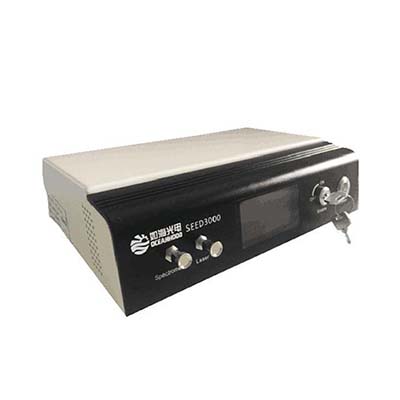
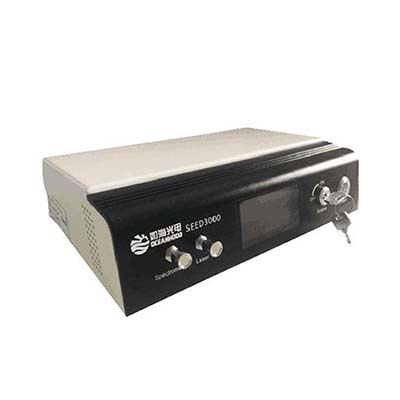
SEED3000 Raman Detection System
- PRODUCT DETAIL
SEED3000 Raman Detection System
Product Introduction
The
SEED3000 Raman Detection System is an integrated Raman spectroscopy analysis
solution designed for routine testing, rapid screening, and material
identification. Developed for non-professional users, it combines a compact
instrument, professional Raman probe, and Uspectral-Ram Analysis Software for
convenient operation across a wide range of applications.
Using
785 nm laser excitation, the SEED3000 provides rapid, non-destructive
qualitative and quantitative analysis with minimal sample preparation. It can
analyze small sample quantities as well as aqueous samples, solutions, and
suspensions, helping preserve sample integrity while collecting valuable
spectral information.
With
its compact design and flexible probe configuration, the SEED3000 Raman
analyzer is suitable for laboratory analysis and on-site material screening in
food safety, pharmaceutical testing, jewelry appraisal, security inspection,
and other material analysis applications.
Performance Features
• Minimal
Sample Preparation: Supports direct analysis without routine
procedures such as sectioning, staining, embedding, or dehydration.
• Non-Destructive
Testing: Analyzes small sample quantities while helping preserve sample integrity.
• Rapid Material
Identification: Raman spectral fingerprints support substance
identification and database comparison.
• Qualitative
and Quantitative Analysis: Suitable for material screening and
concentration-related analysis when supported by appropriate calibration
methods.
• Suitable for Aqueous
Samples: Raman analysis is generally less affected by water than many infrared
techniques, enabling analysis of solutions and suspensions.
• High-Resolution
Spectral Features: Sharp Raman peaks facilitate spectral
interpretation, library matching, and substance differentiation.
• Stable Laser
Excitation: Features a 785 ± 0.5 nm excitation wavelength, laser noise
of ≤1% RMS, and power stability of ≤2% peak-to-peak over two hours.
• Flexible Probe
Connection: Professional Raman probe with SMA905 output interface
supports convenient system integration.
• Compact Integrated
Design: Measures 220 × 143.1 × 58.6 mm and weighs 3.5 kg for convenient deployment.
Working Principle
The
SEED3000 Raman Detection System uses Raman spectroscopy to characterize
materials through the interaction between laser light and molecular vibrations.
When the 785 nm laser illuminates a sample, a small proportion of the scattered
light undergoes an energy shift associated with molecular vibrational and
rotational states.
The
instrument measures the Raman shift over a spectral range of 200–3200 cm⁻¹ to generate a characteristic spectrum. The accompanying
analysis software can compare spectral features with reference data to support
substance identification and, with suitable calibration, quantitative analysis.
Because
the Raman shift is characteristic of molecular structure rather than the
incident laser wavelength itself, Raman spectroscopy is useful for
distinguishing materials and analyzing a broad range of sample types.
Technical Parameters
Parameter
Specification
Model
SEED3000
Overall
Dimensions
220
× 143.1 × 58.6 mm
Total
Weight
3.5
kg
Spectral
Range
200–3200
cm⁻¹
Spectral
Resolution
13
cm⁻¹ at 1000 cm⁻¹
Excitation
Wavelength
785
± 0.5 nm
Laser
Linewidth
<
0.1 nm
Wavelength
Stability
<
0.01 nm/°C (standard)
Laser
Noise
≤1%
RMS (10 Hz–100 MHz)
Laser
Power Stability
≤2%
P-P over 2 hours
Laser
Lifetime
10,000
hours
Adjustable
Output Power
0–480
mW
Integration
Time
1
ms–20 s
Laser
Filter Cutoff Depth
OD6
Probe
Working Focal Length
7.5
mm
Excitation
Fiber
105
μm VIS-NIR
Receiver
Fiber
200
μm VIS-NIR
Output
Interface
SMA905
Power
Supply
100–240
VAC, 50/60 Hz
Operating/Storage
Temperature
0–45°C
Operating/Storage
Humidity
5%–80%
Analysis
Software
Uspectral-Ram
Analysis Software
Application Scenarios
• Food
Safety Testing: Rapid screening and identification of selected
ingredients, raw materials, and potential contaminants.
• Pharmaceutical
Analysis: Material identification and raw-material verification, subject to method
validation.
• Jewelry
Appraisal: Raman spectral analysis to support the identification of gemstones and other
materials.
• Security Inspection: Field
screening of unknown materials and substances.
• Chemical and Material
Analysis: Characterization and comparison of solids, liquids, solutions, and suspensions.
• Research and Education: Raman
spectroscopy experiments, spectral library development, and routine laboratory
analysis.
• On-Site Testing: Portable
deployment for preliminary material screening where conventional laboratory
preparation is impractical.
SEED3000 vs. Conventional Material Analysis Methods
Comparison Item
SEED3000 Raman Detection System
Conventional Laboratory Methods
Sample
Preparation
Often
requires minimal preparation
May
require extraction, drying, staining, or other pretreatment
Sample
Integrity
Supports
non-destructive analysis
Some
methods consume or alter samples
Water
Interference
Generally
low for Raman measurements
Varies
by analytical technique
Testing
Location
Suitable
for laboratory and field screening
Some
instruments require dedicated laboratory facilities
Identification
Method
Raman
spectral fingerprint and library comparison
Depends
on the analytical method
Quantitative
Analysis
Possible
with appropriate calibration
Depends
on the method and validated procedure
Operating
Requirements
Designed
for routine use by non-specialist users
May
require specialized training, depending on the method
Note: Actual performance depends on the sample, measurement
conditions, spectral library, accessories, and validated analytical method.
Raman spectroscopy does not identify every substance under all conditions.
Frequently Asked Questions
Q1: What is the SEED3000 Raman Detection System used for?
It
is designed for rapid material screening, Raman spectral analysis, and
substance identification in areas such as food safety, pharmaceuticals, jewelry
appraisal, security inspection, and materials research.
Q2: Does the SEED3000 require sample pretreatment?
Many
samples can be analyzed with minimal preparation. Routine procedures such as
sectioning, staining, and embedding are generally unnecessary, although some
samples may require suitable handling or preparation.
Q3: Is Raman analysis destructive to samples?
Raman
spectroscopy is generally a non-destructive analytical technique. However,
laser power, exposure time, and sample sensitivity should be considered to
avoid potential heating or photochemical changes.
Q4: Can the SEED3000 analyze aqueous samples?
Yes.
Raman spectroscopy is generally less affected by water than infrared absorption
techniques, making it suitable for many aqueous solutions and suspensions.
Q5: What is the excitation wavelength of the SEED3000?
The
system uses a 785 ± 0.5 nm laser with a linewidth below 0.1 nm.
Q6: What spectral range does the instrument cover?
Its
specified Raman spectral range is 200–3200 cm⁻¹, with a spectral resolution of 13 cm⁻¹ at 1000 cm⁻¹.
Q7: Can the SEED3000 perform quantitative analysis?
It
can support quantitative analysis when an appropriate calibration model and
validated analytical method are available. Quantitative performance depends on
the sample and measurement conditions.
Q8: What software is supplied with the system?
The
system is designed to work with Uspectral-Ram Analysis Software for spectral
analysis and comparison. Specific database content and supported accessories
should be confirmed with the supplier.
Q9: Is the SEED3000 suitable for field testing?
Its
compact dimensions, 3.5 kg weight, and integrated design make it suitable for
portable deployment and on-site screening. Operation requires an appropriate
power supply of 100–240 VAC at 50/60 Hz.