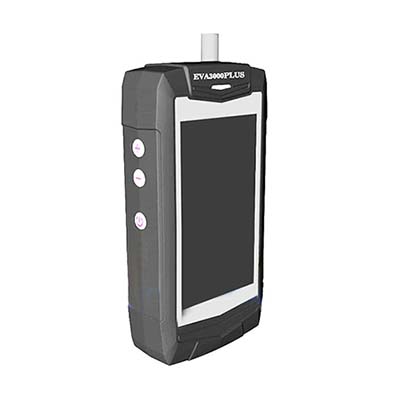
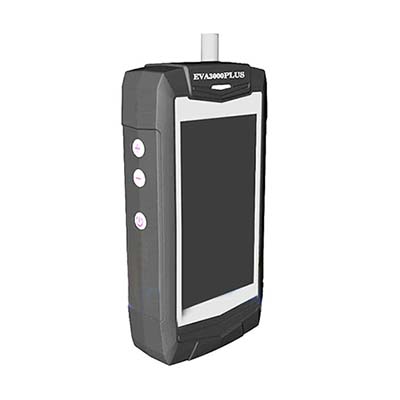
EVA3000Plus Handheld Raman Dangerous Goods Tester
- PRODUCT DETAIL
EVA3000Plus Handheld Raman Dangerous Goods Tester
Product Introduction
The
EVA3000Plus Handheld Raman Dangerous Goods Tester is a portable analytical
instrument designed for rapid on-site screening and identification of
potentially hazardous and controlled substances. Using 785 nm laser Raman
spectroscopy, it analyzes samples in solid, powder, liquid, and aqueous
solution forms, supporting security inspections and field investigations. Its
integrated sampling, spectral acquisition, database searching, and
similarity-matching functions deliver results within seconds under suitable
testing conditions. The device features a built-in database of approximately
200 contraband entries, a 5-inch high-definition touchscreen, an 8-megapixel
camera, and GPS, 4G, Wi-Fi, and Bluetooth connectivity. With its lightweight
handheld design and IP65-rated enclosure, the EVA3000Plus is suitable for
mobile screening applications in security, customs, law enforcement, and
hazardous-material inspection.
Performance Features
• Rapid On-Site Analysis: Acquires
Raman spectra and compares results with the built-in database to support
identification within seconds, depending on the sample and measurement
conditions.
• 785
nm Raman Excitation: Uses a semiconductor laser with a specified
wavelength of 785 ± 0.5 nm for Raman spectral analysis.
• Broad Spectral
Coverage: Covers 200–3200 cm⁻¹,
supporting the analysis of a wide range of molecular vibrational signatures.
• Integrated
Substance Database: Includes approximately 200 contraband database
entries for rapid spectral matching and preliminary identification.
• Non-Destructive
Measurement Potential: Enables direct analysis through compatible
glass or plastic protective barriers, reducing the need to open certain sample
containers.
• High-Sensitivity
Detection: Designed to support identification of weak Raman signals and small sample
quantities, subject to substance properties and testing conditions.
• Integrated Camera: The
8-megapixel camera supports on-site photographic documentation and inspection
records.
• Intelligent Touchscreen
Operation: The 720 × 1280 capacitive touchscreen provides an interface for instrument
control and spectral analysis.
• Multiple Communication
Options: Built-in 4G, Wi-Fi, Bluetooth, and GPS support connectivity, location tagging,
and compatible cloud-based workflows.
• Automatic
Power Adjustment: Adaptive laser output from 0 to 500 mW
supports adjustment to different measurement requirements.
• Rugged
Portable Design: The IP65-rated enclosure provides protection against dust
and water jets, making the instrument suitable for field use within its
specified environmental limits.
• Compact and
Lightweight: The device measures 180 × 95 × 38 mm and weighs less than
800 g for convenient transport and operation.
Working Principle
The
EVA3000Plus uses Raman spectroscopy to characterize the molecular composition
of a sample. A 785 nm laser illuminates the target, and a small portion of the
scattered light undergoes an energy shift caused by molecular vibrations. This
Raman-scattered light is collected by the optical probe, filtered to suppress
Rayleigh scattering, and analyzed to generate a Raman spectrum.
The
instrument's software compares the measured spectrum with entries in its
internal substance database and evaluates spectral similarity to provide a
preliminary identification result. Compatible samples may be analyzed through
suitable transparent packaging, depending on packaging materials, fluorescence,
sample properties, and measurement conditions. Results should be interpreted by
trained personnel, particularly when decisions involve hazardous or controlled
substances.
Technical Parameters
Parameter
Specification
Model
EVA3000Plus
Instrument
Type
Handheld
Raman dangerous goods tester
Excitation
Wavelength
785
± 0.5 nm
Laser
Linewidth
<0.1
nm
Spectral
Range
200–3200
cm⁻¹
Spectral
Resolution
15
cm⁻¹ at 1000 cm⁻¹
Laser
Lifetime
10,000
hours
Laser
Output Power
0–500
mW, adaptive
Integration
Time
1
ms–10 s, adaptive
Rayleigh
Rejection
OD6
Probe
Working Focal Length
7.5
mm
Built-in
Database
Approximately
200 contraband entries
Camera
8
megapixels
Display
5-inch
capacitive touchscreen
Display
Resolution
720
× 1280 pixels
Network
Connectivity
4G,
Wi-Fi, Bluetooth, GPS
Input
Interface
Micro
USB
Power
Supply
DC
5 V adapter
Protection
Rating
IP65
Dimensions
180
× 95 × 38 mm
Weight
<800
g
Operating
Temperature
0–45°C
Operating
Humidity
5–80%
RH
Application Scenarios
• Security Screening: Supports
preliminary identification of suspicious powders, liquids, and other materials
during security inspections.
• Law
Enforcement and Field Investigations: Provides portable
Raman analysis for field screening and evidence documentation.
• Customs
and Border Inspection: Assists trained personnel with the screening
of suspicious substances and chemical materials.
• Chemical Precursor
Screening: Supports spectral comparison of substances that may require further regulatory
or laboratory examination.
• Hazardous-Material
Inspection: Helps identify unknown materials for preliminary risk
assessment when appropriate spectral references are available.
• Industrial
and Laboratory Safety: Supports field analysis of selected chemicals
and materials in compatible containers.
• Emergency
Response Support: Provides rapid preliminary spectral
information to assist qualified response teams in evaluating unknown
substances.
Important: The instrument provides screening and spectral
matching results, not definitive legal or forensic confirmation. Suspected
explosives, narcotics, or other hazardous materials should be handled according
to applicable safety procedures, with confirmatory laboratory testing performed
when required.
EVA3000Plus vs. Conventional Laboratory Raman Spectrometers
Comparison Item
EVA3000Plus Handheld Raman Tester
Conventional Laboratory Raman Spectrometer
Design
Portable
handheld unit
Typically
benchtop or laboratory-based
Excitation
Wavelength
785
nm
Depends
on model
Spectral
Range
200–3200
cm⁻¹
Depends
on model
Sample
Screening
Designed
for rapid field screening
Commonly
used for laboratory analysis
Database
Matching
Built-in
database of approximately 200 contraband entries
Depends
on software and database
Sample
Containers
Can
measure through compatible glass or plastic barriers
Depends
on optical configuration and accessories
Display
Integrated
5-inch touchscreen
Often
computer-based or integrated display
Field
Documentation
Built-in
8 MP camera and GPS
Depends
on system configuration
Connectivity
4G,
Wi-Fi, Bluetooth, GPS
Depends
on model
Environmental
Protection
IP65-rated
enclosure
Depends
on instrument design
Typical
Use
Mobile
screening and preliminary identification
Laboratory
characterization and specialized analysis
Note: This comparison describes typical instrument
configurations. Analytical performance and identification reliability depend on
the specific model, sample, and operating conditions.
Frequently Asked Questions
1. What is the EVA3000Plus Handheld Raman Dangerous Goods
Tester used for?
It
is designed for rapid field screening and preliminary identification of
suspicious substances, including selected chemicals, powders, and liquids,
using Raman spectral analysis.
2. Which substances can the EVA3000Plus analyze?
Its
intended applications include screening for explosives, narcotics, chemical
precursors, and other substances represented in its database. Actual
identification capability depends on the database contents, sample
characteristics, and measurement conditions.
3. What is the excitation wavelength of the EVA3000Plus?
The
instrument uses a 785 ± 0.5 nm semiconductor laser with a specified linewidth
below 0.1 nm.
4. Can samples be tested through glass or plastic
packaging?
Yes,
the instrument is designed to support measurements through compatible glass and
plastic barriers. Success depends on packaging composition, thickness,
fluorescence, and the optical properties of the sample.
5. How quickly can the EVA3000Plus provide results?
The
system is designed to provide preliminary identification results within seconds
for suitable samples. Actual analysis time varies with integration settings,
signal strength, and database matching requirements.
6. How large is the built-in substance database?
The
supplied specifications indicate approximately 200 contraband database entries.
Users should confirm the available substance library and any database expansion
options with the supplier.
7. Is the EVA3000Plus suitable for outdoor inspections?
Its
IP65-rated enclosure provides dust protection and resistance to water jets.
However, the specified operating temperature is 0–45°C, and the instrument
should be used within its stated environmental limits.
8. What connectivity options does the tester support?
It
supports 4G, Wi-Fi, Bluetooth, and GPS. These features can facilitate
communication, location information, and compatible cloud-based data workflows.
9. Can the EVA3000Plus replace laboratory testing?
No.
It is primarily a screening and preliminary identification instrument.
Suspected controlled or hazardous substances may require confirmatory analysis
using validated laboratory methods and appropriate chain-of-custody procedures.