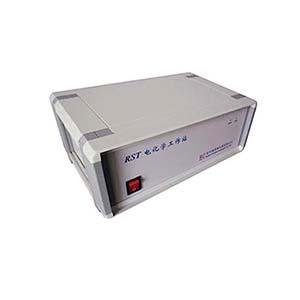
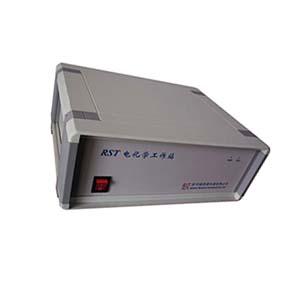
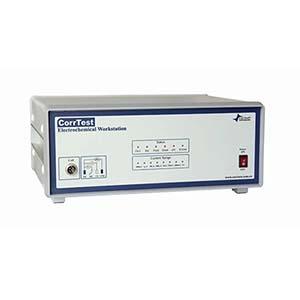
RST-5210 Laboratory Electrochemical Analyzer Workstation

- PRODUCT DETAIL
RST-5210 Laboratory Electrochemical Analyzer Workstation
Product Introduction
The RST-5210 Laboratory Electrochemical Analyzer Workstation is a multifunctional electrochemical testing instrument designed for laboratory research, electrochemical analysis, and electrode reaction studies. It supports more than 10 electrochemical techniques, including cyclic voltammetry (CV), linear sweep voltammetry (LSV), chronoamperometry (CA), chronocoulometry (CC), differential pulse voltammetry (DPV), normal pulse voltammetry (NPV), square wave voltammetry (SWV), and bulk electrolysis (BE).
With a wide scan-rate range, programmable pulse parameters, rotating disk electrode (RDE) control, and selectable data lengths, the RST-5210 provides flexible experimental control for electrochemical measurements, reaction kinetics investigations, and electrode performance evaluation.
Performance Features
• Multifunctional analysis: Supports 15 listed electrochemical functions and measurement methods.
• Wide scan-rate range: CV and LSV scan speeds from 0.000001 to 5,000 V/s.
• Flexible pulse control: Adjustable pulse widths for CA, CC, DPV, and NPV measurements.
• High-frequency square wave voltammetry: SWV frequency range from 1 to 100,000 Hz.
• RDE control: Provides a 0–10 V output for rotating disk electrode control.
• Extended data acquisition: Selectable maximum data lengths from 128,000 to 4,096,000 points.
• Multiple electrochemical modes: Supports current-time measurements, pulse amperometric methods, open-circuit potential monitoring, and bulk electrolysis.
• Auxiliary cell control: Provides control outputs for nitrogen, mixing, and knocking functions, subject to compatible cell-system configuration.
Working Principle
The RST-5210 controls electrochemical experiments by applying programmed potentials or currents to an electrode system and measuring the resulting electrical response. Depending on the selected technique, the workstation records current, charge, or potential as a function of time or applied potential.
For example, cyclic voltammetry scans the electrode potential forward and backward to investigate redox behavior, while chronoamperometry records current over time at a controlled potential. Differential pulse and square wave voltammetry use programmed potential pulses to help characterize electroactive substances. Bulk electrolysis supports electrochemical conversion through sustained electrolysis.
The workstation processes and records measurement data for subsequent analysis of electrode reactions, electrochemical kinetics, and material properties.
Technical Parameters
|
Parameter |
Specification |
|
Model |
RST-5210 |
|
Product Type |
Laboratory Electrochemical Analyzer Workstation |
|
Cyclic Voltammetry |
CV |
|
Linear Sweep Voltammetry |
LSV |
|
Chronoamperometry |
CA |
|
Chronocoulometry |
CC |
|
Differential Pulse Voltammetry |
DPV |
|
Normal Pulse Voltammetry |
NPV |
|
Square Wave Voltammetry |
SWV |
|
Time-Current Curve |
i-t |
|
Differential Pulse Amperometry |
DPA |
|
Double Differential Pulse Amperometry |
DDPA |
|
Three-Pulse Amperometry |
TPA |
|
Bulk Electrolysis |
BE |
|
Open-Circuit Potential-Time Curve |
OCPT |
|
CV Reaction Simulation |
Supports CV stimulation with selectable reaction mechanisms |
|
RDE Control Output |
0–10 V |
|
CV/LSV Scan Rate |
0.000001–5,000 V/s |
|
CA/CC Pulse Width |
0.0001–1,000 s |
|
CA/CC Step Times |
320 |
|
DPV/NPV Pulse Width |
0.0001–10 s |
|
SWV Frequency |
1–100,000 Hz |
|
Electrolytic Cell Control Outputs |
Nitrogen, mixing, and knocking |
|
Selectable Maximum Data Length |
128,000–4,096,000 points |
Note: The supplied specifications do not include current ranges, potential ranges, potential resolution, current resolution, or communication interfaces. Confirm these parameters with the manufacturer when selecting the workstation for a specific application.
Application Scenarios
• Electrochemical research: Investigating electrode reactions and electrochemical behavior.
• Battery and energy materials: Characterizing electrode materials and studying redox processes.
• Corrosion research: Evaluating electrochemical responses associated with corrosion and protective coatings.
• Catalyst development: Studying electrocatalytic activity and reaction kinetics.
• Chemical analysis: Using voltammetric techniques to investigate electroactive compounds.
• Materials science: Evaluating conductive materials, electrode interfaces, and functional materials.
• Electrode kinetics studies: Analyzing reaction behavior through current, charge, and potential measurements.
• Rotating disk electrode experiments: Supporting compatible RDE-based hydrodynamic electrochemical investigations.
RST-5210 vs. Conventional Electrochemical Analyzers
|
Feature |
RST-5210 Workstation |
Basic Electrochemical Analyzer |
|
Analysis Methods |
15 listed methods and functions |
Often limited to selected techniques |
|
CV/LSV Scan Rate |
0.000001–5,000 V/s |
Depends on model |
|
Pulse Techniques |
CA, CC, DPV, NPV, SWV, DPA, DDPA, TPA |
Depends on model |
|
SWV Frequency |
1–100,000 Hz |
Depends on model |
|
RDE Control |
0–10 V output |
May require external control |
|
Data Length |
Selectable up to 4,096,000 points |
Depends on system |
|
Bulk Electrolysis |
Supported |
Depends on model |
|
Research Flexibility |
Suitable for diverse electrochemical experiments |
Depends on available functions |
Frequently Asked Questions
1. What is the RST-5210 electrochemical workstation used for?
It is designed for laboratory electrochemical analysis, electrode characterization, reaction kinetics research, and material performance testing.
2. Which electrochemical methods does it support?
Supported methods include CV, LSV, CA, CC, DPV, NPV, SWV, i-t, DPA, DDPA, TPA, bulk electrolysis, and open-circuit potential-time measurements, along with RDE control and CV reaction simulation.
3. What is the scan-rate range for CV and LSV?
The specified scan-rate range is 0.000001–5,000 V/s.
4. What is the square wave voltammetry frequency range?
The specified SWV frequency range is 1–100,000 Hz.
5. Does the RST-5210 support rotating disk electrode experiments?
Yes. It provides a 0–10 V RDE control output. Confirm compatibility with the selected rotating disk electrode controller or drive system.
6. How much data can the workstation record?
The maximum data length is selectable from 128,000 to 4,096,000 points.
7. Can it be used for battery and catalyst research?
Yes. Its voltammetric, amperometric, and electrolysis functions can support compatible battery-material, catalyst, and electrode-reaction studies.
8. Can the workstation be used for quantitative electrochemical analysis?
Yes. Techniques such as DPV, SWV, and amperometry can be used for quantitative analysis when appropriate calibration, experimental conditions, and validated analytical methods are established.

NEXT:YM-200 Portable ATP Bacteria Detector