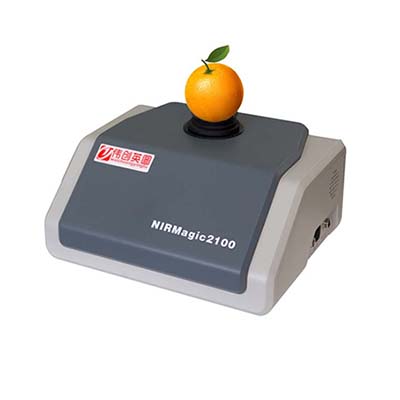
NIRMagic 2100 Benchtop Fruit NIR Near-Infrared Spectrometer
- PRODUCT DETAIL
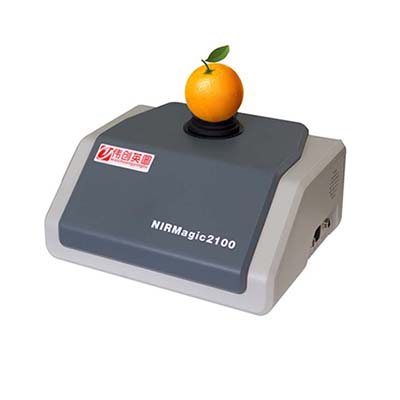
NIRMagic 2100 Benchtop Fruit NIR Near-Infrared Spectrometer
Product Introduction
The NIRMagic 2100 Benchtop Fruit NIR Spectrometer is designed for rapid, nondestructive fruit quality assessment using near-infrared spectroscopy. With a wavelength range of 600–1100 nm and an analysis time of approximately 5 seconds, it supports qualitative discrimination and fruit quality analysis without damaging samples.
The instrument is suitable for applications throughout the fruit supply chain, including orchard management, harvest planning, fruit grading, disease screening, and storage and transportation management. Its built-in calibration and reference modules help maintain measurement accuracy and improve repeatability, while the embedded control system and 4.3-inch touchscreen simplify daily operation.
Performance Features
1. Nondestructive testing: Analyzes fruit samples without destroying them, helping preserve samples for further use.
2. Rapid analysis: Completes a measurement in approximately 5 seconds, supporting efficient inspection and sorting workflows.
3. Intelligent operation: Features an embedded control system and a 4.3-inch LCD touchscreen for convenient instrument control.
4. Built-in calibration module: Supports periodic self-inspection to help maintain measurement accuracy.
5. Real-time reference module: Provides real-time referencing to improve measurement repeatability.
6. Rechargeable battery module: Supports up to 5 hours of continuous measurement under specified operating conditions.
7. Data and spectral storage: Provides 8 GB of storage, with capacity for more than 2,000 analysis results or spectra according to the supplied specifications.
8. USB communication: Uses a USB 2.0 interface for data communication and connection to compatible systems.
9. Secondary development support: Allows integration or customization for suitable application-specific workflows.
10. Compact benchtop design: Measures 320 × 240 × 150 mm and weighs approximately 3.5 kg.
Working Principle
The NIRMagic 2100 uses near-infrared spectroscopy to obtain spectral information from fruit samples. When near-infrared light interacts with fruit tissue, chemical constituents and physical characteristics influence the light's absorption and reflection.
A CCD line-array detector collects the resulting spectral signal across the instrument's 600–1100 nm wavelength range. The system processes the spectral data and uses appropriate calibration models to support qualitative discrimination and fruit quality analysis.
The built-in calibration and reference modules support routine instrument checks and reference correction. Actual analytical performance depends on the calibration model, fruit variety, sample conditions, and the specific quality indicators being evaluated.
Technical Parameters
|
Parameter |
Specification |
|
Model |
NIRMagic 2100 |
|
Instrument type |
Benchtop fruit near-infrared spectrometer |
|
Detector |
CCD line-array detector |
|
Wavelength range |
600–1100 nm |
|
Wavelength accuracy |
0.2 nm |
|
Wavelength repeatability |
0.05 nm |
|
Analysis time |
≤5 seconds |
|
Display |
4.3-inch LCD touchscreen |
|
Operating system |
Embedded control system |
|
Communication interface |
USB 2.0 |
|
Analysis result storage |
More than 2,000 records, as specified |
|
Spectral storage |
More than 2,000 spectra, as specified |
|
Storage capacity |
8 GB |
|
Storage groups |
99 groups |
|
Continuous operating time |
Up to 5 hours |
|
Light source |
12 V / 20 W |
|
Light source life |
More than 5,000 hours |
|
Operating temperature |
5–40°C |
|
Humidity range |
5%–95% (confirm whether relative humidity and non-condensing conditions apply) |
|
Power supply |
DC 12 V |
|
Dimensions (L × W × H) |
320 × 240 × 150 mm |
|
Weight |
Approximately 3.5 kg |
Application Scenarios
• Orchard and plant management: Supports nondestructive fruit quality screening to assist crop management and harvest decisions.
• Harvest maturity assessment: Helps evaluate fruit samples using suitable calibration models before picking.
• Fruit grading and sorting: Supports rapid qualitative classification and quality assessment during post-harvest handling.
• Disease screening research: Provides spectral data that may support screening models for selected fruit abnormalities or diseases when appropriate calibration models are available.
• Storage management: Assists quality monitoring during fruit storage and inventory management.
• Transportation and distribution: Supports fruit quality checks during logistics and supply-chain handling.
• Agricultural research and development: Provides spectral measurements for research into fruit characteristics, quality prediction, and NIR-based analytical models.
NIRMagic 2100 vs. Conventional Fruit Quality Testing Methods
|
Comparison Item |
NIRMagic 2100 NIR Spectrometer |
Conventional Destructive Testing |
|
Sample condition |
Nondestructive measurement |
Often requires cutting, extraction, or other sample preparation |
|
Analysis speed |
Approximately 5 seconds per measurement |
Depends on the analytical method and preparation time |
|
Sample reuse |
Sample can generally remain intact |
Sample may be consumed or altered |
|
Measurement consistency |
Built-in reference and calibration modules support repeatability |
Depends on method, operator, and instrument |
|
Operating interface |
Embedded control system with touchscreen |
Varies by testing method |
|
Data storage |
8 GB storage; more than 2,000 results or spectra as specified |
Depends on the equipment and data system |
|
Best suited for |
Rapid screening and model-based fruit quality assessment |
Reference analysis, confirmatory testing, or methods requiring direct chemical measurement |
Note: NIR spectroscopy does not automatically identify every quality attribute. Quantitative results for parameters such as soluble solids, maturity, or internal defects require suitable calibration models validated for the relevant fruit types and measurement conditions.
Frequently Asked Questions
1. What is the NIRMagic 2100 used for?
The NIRMagic 2100 is used for rapid, nondestructive fruit quality assessment and qualitative discrimination. Typical applications include orchard management, harvest grading, research screening, and storage quality monitoring.
2. How long does one measurement take?
The specified analysis time is no more than 5 seconds, enabling rapid sample screening.
3. Does the NIRMagic 2100 damage fruit samples?
No. It is designed for nondestructive testing, allowing fruit samples to remain intact during measurement under normal operating conditions.
4. What is the wavelength range of the instrument?
The NIRMagic 2100 operates over a wavelength range of 600–1100 nm, with a specified wavelength accuracy of 0.2 nm and wavelength repeatability of 0.05 nm.
5. Can it measure fruit sugar content or maturity?
It may support the prediction of selected quality indicators, such as soluble solids or maturity, when suitable calibration models are available and validated for the relevant fruit types. Confirm the supported indicators and model availability with the supplier.
6. How does the instrument maintain measurement consistency?
It includes a standard calibration module for periodic self-inspection and a reference module for real-time referencing. These functions are designed to help maintain accuracy and improve repeatability.
7. Can the NIRMagic 2100 operate without a continuous external power connection?
The instrument includes a built-in battery module that supports up to 5 hours of continuous measurement. Actual battery runtime may vary with operating conditions.
8. How much data can the instrument store?
The supplied specifications list 8 GB of storage, more than 2,000 analysis results, more than 2,000 stored spectra, and 99 storage groups. The exact relationship between storage groups and individual records should be confirmed with the manufacturer.
9. Can the instrument be integrated into a customized testing system?
Yes. Secondary development is supported. Integration requirements, software interfaces, and development documentation should be confirmed with the supplier.