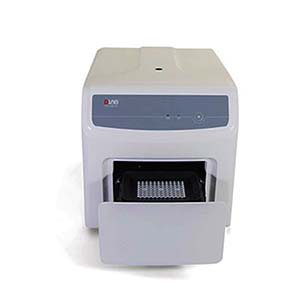
DLAB Accurate 96 Real-Time Quantitative PCR System
- PRODUCT DETAIL
DLAB Accurate 96 Real-Time Quantitative PCR System
Product Introduction
The
DLAB Accurate 96 real-time quantitative PCR (qPCR) system is a high-performance
molecular biology instrument designed for real-time nucleic acid amplification
and fluorescence detection. Featuring advanced optical scanning technology,
time-resolved signal separation, and precise thermal control, this 96-sample
qPCR analyzer delivers high sensitivity, excellent temperature uniformity, and
reliable quantitative results.
Supporting
4 or 6 fluorescence channels, the Accurate 96 enables simultaneous detection of
multiple target genes in a single reaction, with up to five target genes
detected across 96 samples. Its advanced optical design helps minimize
fluorescence crosstalk and edge effects without requiring fluorescence
correction, simplifying experimental workflows and improving measurement
consistency.
With
rapid thermal cycling, a broad dynamic range, and user-friendly operating
software, the DLAB Accurate 96 real-time PCR system is suitable for molecular
biology research, gene expression analysis, nucleic acid quantification, and
other fluorescence-based PCR applications.
Performance Features
1. High-Throughput
96-Well Detection: Supports simultaneous analysis of 96 samples,
enabling efficient processing of large experimental batches.
2. Multiplex
Fluorescence Detection: Supports 4 or 6 fluorescence channels and
simultaneous detection of up to five target genes in 96 samples.
3. Reduced Fluorescence
Crosstalk: Advanced optical design minimizes interference between fluorescence channels
and reduces edge effects without fluorescence correction.
4. High-Sensitivity
Optical System: An innovative scanning detection system with a
photomultiplier tube (PMT) supports sensitive fluorescence measurement and
high-resolution analysis.
5. Rapid and Accurate
Scanning: Time-resolved signal separation technology helps distinguish fluorescence
signals efficiently for reliable real-time quantification.
6. Precise Temperature
Control: Peltier-based thermal cycling, zoned temperature control, and edge temperature
compensation improve thermal stability and uniformity.
7. Fast Thermal
Cycling: Maximum heating and cooling rates of 6°C/s help shorten PCR run times and
improve laboratory throughput.
8. Broad Quantification
Range: A dynamic range of up to 10 orders of magnitude supports the quantitative
analysis of targets across a wide concentration range.
9. User-Friendly
Operation: An ergonomic instrument design and intuitive software facilitate routine
testing, data analysis, and laboratory workflows.
Working Principle
The
DLAB Accurate 96 real-time quantitative PCR system combines polymerase chain
reaction (PCR) amplification with real-time fluorescence monitoring to quantify
target nucleic acids.
1. Sample Preparation: Nucleic
acid samples are mixed with PCR reagents, primers, probes, and suitable
fluorescent dyes before being dispensed into the 96-well reaction plate.
2. Thermal Cycling: A
Peltier-based temperature control system precisely regulates denaturation,
annealing, and extension stages to support target DNA amplification.
3. Fluorescence
Excitation: High-efficiency LED light sources excite fluorescent dyes
at their corresponding wavelengths.
4. Optical Signal
Detection: The optical scanning system and PMT detect fluorescence signals during PCR
cycling. Time-resolved signal separation helps distinguish signals from
different fluorescence channels.
5. Quantitative
Analysis: The instrument records fluorescence changes throughout amplification and
analyzes the resulting amplification curves to determine target nucleic acid
quantities.
Technical Parameters
Parameter
Specification
Sample
Capacity
96
samples
Excitation
Light Source
4/6
monochromatic high-efficiency LEDs
Reaction
Volume
10–50
μL
Detection
Device
Photomultiplier
tube (PMT)
Thermal
Cycling Technology
Peltier
Detection
Mode
Time-resolved
real-time scanning
Maximum
Heating/Cooling Rate
6°C/s
Excitation
Wavelength Range
455–650
nm
Detection
Wavelength Range
510–715
nm
Temperature
Range
4–100°C
Fluorescence
Channels
4
or 6 channels
Temperature
Accuracy
±0.2°C
Sensitivity
Single-copy
gene detection (as specified)
Temperature
Uniformity
±0.2°C
at 60°C; ±0.2°C at 95°C
Copy
Number Resolution
Distinguishes
a 1.33-fold difference in copy number within a single reaction
Temperature
Gradient Range
30–100°C
(also listed as 1–36°C in the source specifications; confirmation
recommended)
Dynamic
Range
Up
to 10 orders of magnitude
Supported
Fluorescent Dyes
FAM,
SYBR Green, VIC, JOE, HEX, TET, ABY, NED, TAMRA, Cy3, ROX, Texas Red, JUN,
Mustang Purple, Cy5, LIZ, Quasar
Note: The source lists two different temperature gradient
ranges, 30–100°C and 1–36°C. Please confirm the correct specification with the
manufacturer before publication.
Application Scenarios
• Gene Expression
Analysis: Quantitative analysis of gene expression levels and changes in transcription.
• Nucleic Acid
Quantification: Measurement of DNA or RNA targets following appropriate
sample preparation and reverse transcription when required.
• Molecular
Biology Research: Investigation of gene regulation, molecular
mechanisms, and biological pathways.
• Multiplex PCR Assays: Simultaneous detection of multiple nucleic acid targets using compatible
fluorescent dyes and assay designs.
• Pathogen Detection
Research: Detection and quantification of microbial or viral nucleic acid targets in
research and laboratory testing workflows.
• Genetic Analysis: Analysis of
genetic markers, target sequences, and other nucleic acid-based research
indicators.
• Biotechnology and
Pharmaceutical Research: Support for molecular testing, assay
development, and experimental quality evaluation.
DLAB Accurate 96 vs. Conventional Real-Time PCR Systems
Comparison Factor
DLAB Accurate 96
Conventional Real-Time PCR Systems
Sample
Throughput
96
samples per run
Depends
on instrument configuration
Multiplex
Capability
4/6
fluorescence channels; up to 5 target genes as specified
Varies
by model and optical configuration
Fluorescence
Crosstalk
Designed
to minimize crosstalk without fluorescence correction
May
require compensation or correction, depending on the system
Optical
Detection
LED
excitation, optical scanning, and PMT detection
Varies
by detection architecture
Thermal
Control
Zoned
temperature control and edge temperature compensation
Depends
on thermal block design
Maximum
Heating/Cooling Rate
Up
to 6°C/s
Varies
by model
Quantitative
Dynamic Range
Up
to 10 orders of magnitude
Depends
on assay and instrument
Operation
Dedicated
operating software and user-oriented design
Depends
on software and interface
Frequently Asked Questions
1. What is the DLAB Accurate 96 real-time quantitative PCR
system used for?
It
is designed for real-time nucleic acid amplification and fluorescence-based
quantification, including gene expression analysis, DNA/RNA quantification,
multiplex PCR, and molecular biology research.
2. How many samples can the Accurate 96 process in one run?
The
system supports 96 samples per run, making it suitable for routine laboratory
testing and higher-throughput research workflows.
3. How many target genes can it detect simultaneously?
According
to the supplied specifications, the system can detect up to five target genes
in 96 samples, subject to the selected channel configuration and compatible
assay design.
4. What fluorescence channels does the system support?
The
instrument is available with 4 or 6 fluorescence channels. Supported dyes
include FAM, SYBR Green, VIC, HEX, ROX, Cy5, and other compatible fluorophores.
5. What is the reaction volume of the DLAB Accurate 96?
The
specified reaction volume is 10–50 μL per reaction.
6. How does the system reduce fluorescence crosstalk?
It
uses an advanced optical scanning system and time-resolved signal separation
technology to distinguish fluorescence signals and reduce interference between
channels.
7. What is the maximum thermal cycling rate?
The
maximum heating and cooling rate is specified as 6°C/s. Actual PCR run time
depends on the selected protocol, reaction chemistry, and thermal cycling
settings.
8. What is the quantitative dynamic range of the Accurate
96?
The
system specifies a dynamic range of up to 10 orders of magnitude. Actual
quantitative performance depends on assay validation, sample quality, and
experimental conditions.
9. What should be considered when selecting fluorescent
dyes?
Choose
dyes that are compatible with the instrument's excitation and detection ranges,
available fluorescence channels, and assay design. For multiplex PCR, ensure
that the selected fluorophores have suitable spectral separation and validated
detection compatibility.
NEXT:TD-220 True Density Analyzer Based on Vacuum Helium Pycnometry