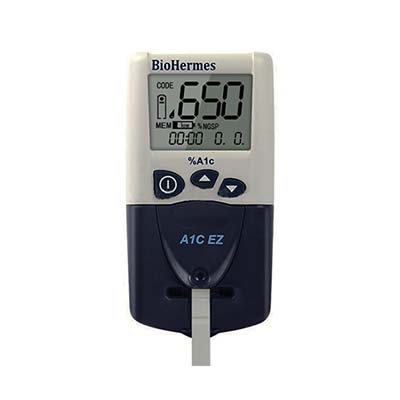
YM01-HBA1C Portable Glycated Hemoglobin Meter
- PRODUCT DETAIL
YM01-HBA1C Portable Glycated Hemoglobin Meter
Product Introduction
The
YM01-HBA1C Portable Glycated Hemoglobin Meter is designed for quantitative
measurement of glycated hemoglobin (HbA1c) as a percentage of total hemoglobin.
It uses boric acid affinity chromatography combined with colorimetric detection
to distinguish stable glycated hemoglobin from other hemoglobin components,
supporting HbA1c testing in clinical and point-of-care settings.
The
system uses a dedicated test kit consisting of a test strip, Buffer A, Buffer
B, and a sampler. Through a selective affinity separation process, stable
glycated hemoglobin is retained through specific interactions between
glucose-derived cis-diol groups and boronic acid groups on the solid-phase
carrier. Other hemoglobin components are separated during the procedure, and
the instrument measures the optical reflection signals to calculate the HbA1c
percentage.
Designed
for use with dedicated consumables, the YM01-HBA1C provides a convenient
testing approach for healthcare facilities and laboratories that require
quantitative glycated hemoglobin measurement. Its affinity-based detection
principle helps support HbA1c assessment for diabetes monitoring workflows.
Actual diagnostic use should follow the manufacturer's instructions and
applicable clinical guidelines.
Performance Features
• Quantitative
HbA1c Measurement: Determines glycated hemoglobin as a percentage
of total hemoglobin.
• Boric
Acid Affinity Chromatography: Uses selective interactions between boronic
acid groups and glucose-derived cis-diol groups to separate stable glycated
hemoglobin.
• Colorimetric Detection: Measures
optical reflection signals from hemoglobin components to calculate the HbA1c
percentage.
• Dedicated Test Kit: Includes
test strips, Buffer A, Buffer B, and a sampler for the specified testing
procedure.
• Convenient Consumable
Packaging: Test strips are available individually packaged with desiccant or in bottles
containing 25 strips, according to the supplied specifications.
• Controlled Buffer
Chemistry: Buffer A has a specified pH of 6.5, while Buffer B has a specified pH of 9.5 to
support the affinity separation process.
• Interference
Evaluation: The supplied specifications identify concentration limits
for several potentially interfering substances, helping users assess test
conditions.
• Point-of-Care
Testing Potential: The portable meter format is intended to
support HbA1c measurement in suitable clinical testing environments.
Working Principle
The
YM01-HBA1C uses boric acid affinity chromatography and colorimetric detection
to quantify glycated hemoglobin.
First,
the prepared blood sample passes through a solid-phase carrier containing
immobilized affinity ligands. Hemoglobin components interact with the carrier
as Buffer A and Buffer B are introduced sequentially.
During
the Buffer A stage, hemoglobin components are retained through interactions
with the solid phase while non-glycated hemoglobin flows through the system.
During the Buffer B stage, boronic acid groups on the carrier selectively
interact with glucose-derived cis-diol groups in stable glycated hemoglobin.
Other hemoglobin components, including unstable glycated hemoglobin and fetal
hemoglobin (HbF), are intended to flow out according to the supplied method
description.
The
instrument then detects the optical reflection associated with the separated
hemoglobin fractions. By processing these signals, it calculates the proportion
of stable glycated hemoglobin relative to total hemoglobin and reports the
HbA1c percentage.
This
affinity-based approach provides a quantitative measurement for HbA1c
assessment. Test performance depends on correct sample preparation, compatible
consumables, operating procedures, and the specific instrument configuration.
Technical Parameters
Interfering Substance Specifications
Interfering Substance
Specified Test Concentration
Unconjugated
Bilirubin
20
mg/dL
Triglycerides
3000
mg/dL
Hemoglobin
500
mg/dL
Acetaminophen
(Paracetamol)
80
μg/mL
Ascorbic
Acid
5
mg/dL
Ibuprofen
120
μg/mL
Acetylsalicylic
Acid
1
mg/dL
Glibenclamide
240
mg/mL
Milt
Fermin (source spelling; identity requires confirmation)
25
μg/mL
Note: These values are reproduced from the supplied
specifications. The source does not clarify whether they represent maximum
concentrations tested without significant interference or another analytical
threshold. The identity and unit of the listed glibenclamide concentration, as
well as the name “Milt Fermin,” should be verified with the manufacturer.
Test Kit and Consumable Specifications
Parameter
Specification
Product
Model
YM01-HBA1C
Product
Type
Portable
glycated hemoglobin (HbA1c) meter
Measurement
Principle
Boric
acid affinity chromatography and colorimetric detection
Measurement
Result
HbA1c
as a percentage of total hemoglobin
Test
Kit Components
Test
strip, Buffer A, Buffer B, sampler
Individual
Test Packaging
One
test strip and desiccant in an aluminum foil bag
Bottle
Packaging
25
test strips per bottle
Test
Strip Materials
Absorbent
pad, polyethylene fiber membrane, reflection element, PET base plate
Buffer
A Composition
Potassium
dihydrogen phosphate, sodium hydroxide, sodium azide
Buffer
A pH
6.5
Buffer
B Composition
Glycine
and sodium hydroxide
Buffer
B pH
9.5
Sampler
Main Material
Impact-resistant
polystyrene
Sampler
Line Material
Polyester,
750D
The supplied source does not specify the HbA1c measurement
range, sample volume, testing time, analytical precision, display
specifications, power supply, memory capacity, or communication interfaces.
These parameters should be confirmed with the manufacturer before purchase or
clinical implementation.
Application Scenarios
1. Diabetes Monitoring
Supports
quantitative HbA1c assessment as part of clinical diabetes management, helping
healthcare professionals evaluate longer-term blood glucose control alongside
other clinical information.
2. Hospital and Clinical Laboratories
Can
be used in suitable clinical testing environments for glycated hemoglobin
measurement with the manufacturer's specified test strips and reagents.
3. Primary Healthcare Facilities
The
portable meter format may support HbA1c testing in primary healthcare settings
where a suitable point-of-care testing workflow is established.
4. Outpatient and Point-of-Care Testing
Designed
to facilitate quantitative HbA1c measurement in clinical environments that
benefit from dedicated testing kits and a compact instrument format.
5. Medical Screening Programs
May
support HbA1c testing as part of structured diabetes screening or follow-up
programs when used according to applicable clinical guidelines and the device's
authorized intended use.
YM01-HBA1C vs. Conventional HbA1c Testing Methods
Comparison Item
YM01-HBA1C
Conventional Laboratory HbA1c Analyzer
Measurement
Principle
Boric
acid affinity chromatography with colorimetric detection
May
use HPLC, immunoassay, enzymatic methods, or other validated techniques
Target
Measurement
HbA1c
percentage of total hemoglobin
HbA1c
measurement
Test
Consumables
Dedicated
strips, buffers, and sampler
Method-specific
reagents, columns, cartridges, or other consumables
Instrument
Format
Portable
meter
Often
a benchtop or automated laboratory system
Testing
Environment
Intended
for suitable clinical and point-of-care workflows
Commonly
used in centralized laboratories; some systems support near-patient testing
Data
Provided
Quantitative
HbA1c result
Quantitative
HbA1c result
Performance
Verification
Requires
confirmation against manufacturer specifications and applicable standards
Depends
on instrument validation, method, and quality-control procedures
This is a general comparison of testing approaches. Actual
accuracy, throughput, interference susceptibility, and clinical suitability
must be evaluated using the specific instrument's validated performance data.
Frequently Asked Questions (FAQ)
Q1: What is the YM01-HBA1C portable glycated hemoglobin
meter used for?
It
is designed to measure HbA1c as a percentage of total hemoglobin, supporting
clinical assessment and monitoring of diabetes.
Q2: What measurement principle does the YM01-HBA1C use?
It
uses boric acid affinity chromatography combined with colorimetric detection.
Boronic acid groups selectively interact with glucose-derived cis-diol groups
in stable glycated hemoglobin.
Q3: What components are included in the HbA1c test kit?
The
specified kit consists of a test strip, Buffer A, Buffer B, and a sampler. The
exact package contents should be confirmed when ordering.
Q4: How are the test strips packaged?
The
supplied specifications describe individual aluminum foil packaging containing
one test strip and a desiccant, as well as bottle packaging containing 25 test
strips.
Q5: What are the pH values of the two buffers?
Buffer
A has a specified pH of 6.5, and Buffer B has a specified pH of 9.5.
Q6: Which substances may interfere with testing?
The
supplied specifications list unconjugated bilirubin, triglycerides, hemoglobin,
acetaminophen, ascorbic acid, ibuprofen, acetylsalicylic acid, glibenclamide,
and another substance identified as “Milt Fermin.” The manufacturer's
instructions should be consulted for validated interference limits.
Q7: Does the supplied specification include the HbA1c
measurement range and accuracy?
No.
Although interference concentrations are provided, the source does not specify
the HbA1c measurement range, analytical accuracy, repeatability, or testing
time. These details should be obtained from the manufacturer.
Q8: Can the YM01-HBA1C be used for point-of-care testing?
Its
portable format is intended to support convenient testing in suitable clinical
environments. Point-of-care use should be confirmed against the instrument's
regulatory status, validated performance, and authorized intended use.
Q9: Why is HbA1c testing important?
HbA1c
reflects average blood glucose exposure over approximately the preceding two to
three months and is used in diabetes diagnosis and monitoring when appropriate
validated methods and clinical criteria are applied. Results should be
interpreted by qualified healthcare professionals.
NEXT:DLAB Accurate 96 Real-Time Quantitative PCR System