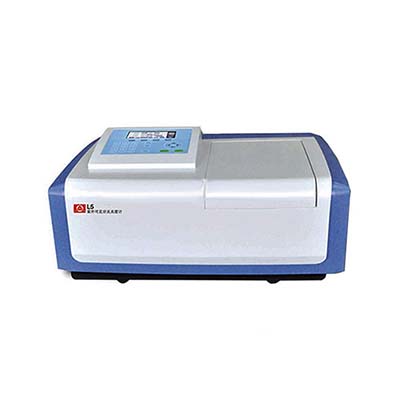
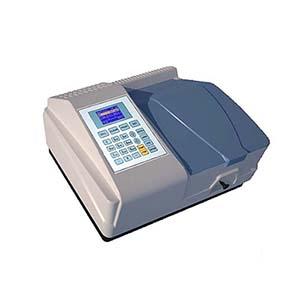
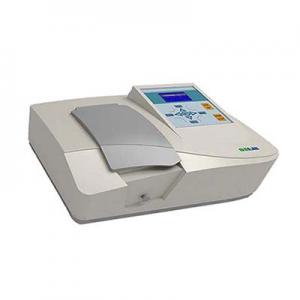
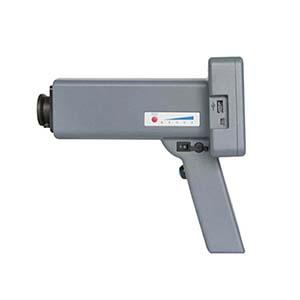
L5 / L5S UV-Vis Spectrophotometer
- PRODUCT DETAIL
Product Introduction
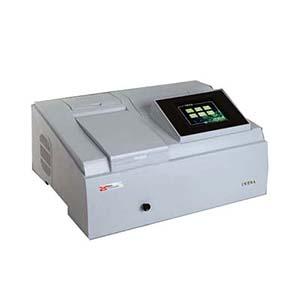
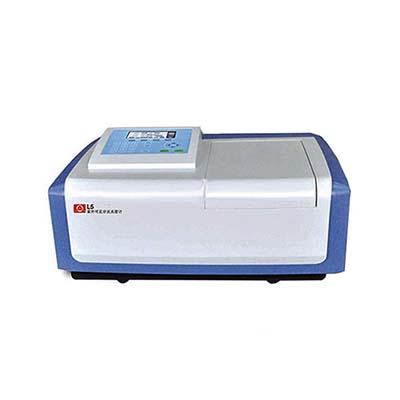
The L5/L5S UV-Vis Spectrophotometer is a laboratory analytical instrument designed for ultraviolet and visible light absorption measurements across a wavelength range of 190–1100 nm. Its double-beam optical monitoring system, holographic grating, and high-resolution monochromator support precise and repeatable measurements for routine analysis, quality control, and scientific research.
Equipped with a 7-inch color LCD touchscreen, the L5/L5S offers convenient operation and multiple measurement functions, including full-wavelength scanning, sub-band scanning, time-based dynamic scanning, wavelength positioning, linear regression, direct concentration reading, and peak detection. Automatic zero and 100% adjustment streamline daily testing, while the linked eight-position sample holder helps improve sample handling efficiency.
The instrument also supports data printing through an integrated thermal printer and PC connectivity through a USB interface. These functions enable spectral data processing, scan-curve management, and storage of test records. The L5S series additionally specifies baseline straightness performance of ±0.002 A, according to the supplied technical information.
Performance Features
• Wide UV-Vis wavelength coverage: Measures across 190–1100 nm for ultraviolet and visible spectrophotometric analysis.
• Double-beam optical monitoring: Uses a proportional double-beam optical structure to support measurement stability.
• High-performance optical system: Combines a holographic grating with a high-resolution monochromator and low stray-light design.
• 7-inch color LCD: Provides a clear interface for convenient parameter setting and instrument operation.
• Automatic zero and 100% adjustment: Simplifies routine measurement preparation.
• Eight-position linked sample holder: Supports efficient sample measurement and handling.
• Multiple scanning modes: Includes full-wavelength, sub-band, and time-based dynamic scanning.
• Advanced analytical functions: Supports wavelength positioning, linear regression, direct concentration readings, and peak detection.
• Thermal printing: Prints measurement results, spectral scans, time-scan graphs, and regression information.
• USB computer connectivity: Supports PC interaction, spectral data processing, and storage of test records.
• Data retention and quick initialization: Retains specified measurement data, spectral graphs, regression equations, and instrument correction information during power-off.
• Long-life deuterium lamp design: Uses a flange-positioned deuterium lamp assembly to simplify replacement and positioning.
Working Principle
The L5/L5S UV-Vis Spectrophotometer operates by directing ultraviolet or visible light through a monochromator to select the required wavelength. The selected light interacts with the sample, and the instrument measures the optical response using its double-beam monitoring system.
By comparing sample and reference light signals, the instrument determines transmittance and absorbance. When a calibration relationship is established, the system can perform linear regression and display concentration values directly. Wavelength scanning and time-based scanning provide additional information about spectral characteristics and changes in absorbance over time.
Automatic zero and 100% adjustment, together with the instrument's optical and electronic design, helps support repeatable laboratory measurements.
Technical Parameters
|
Parameter |
Specification |
|
Models |
L5 / L5S |
|
Instrument Type |
UV-Vis Spectrophotometer |
|
Wavelength Range |
190–1100 nm |
|
Maximum Permissible Wavelength Error |
±0.5 nm |
|
Wavelength Repeatability |
≤0.2 nm |
|
Spectral Bandwidth |
2 nm |
|
Stray Light |
≤0.056% T |
|
Stray Light Test Conditions |
220 nm using NaI; 360 nm using NaNO₂ |
|
Transmittance Range |
0.0–200.0% T |
|
Absorbance Range |
−0.301 to 4.000 A, interpreted from the supplied specification |
|
Maximum Permissible Transmittance Error |
±0.3% T |
|
Transmittance Repeatability |
≤0.15% T |
|
Drift |
≤0.0009 A/h after 2 h warm-up, at 250 nm and 500 nm |
|
Baseline Straightness |
±0.002 A from 200–1090 nm; L5S only |
|
Noise at 100% T |
≤0.15% T |
|
Noise at 0% T |
≤0.10% T |
|
Scanning Speeds |
Fast, medium, slow |
|
Display |
7-inch color LCD |
|
Sample Handling |
Eight-position linked sample holder |
|
Measurement Functions |
Full-wavelength scan, sub-band scan, time scan, wavelength positioning, linear regression, direct concentration reading, peak detection |
|
Data Output |
Thermal printer, USB interface |
|
Data Retention |
Retains specified test data, spectral graphs, regression equations, and instrument corrections |
|
Ambient Temperature |
5–35°C |
|
Relative Humidity |
≤85% |
|
Power Supply |
AC 220 V ±22 V, 50 Hz ±1 Hz |
|
Rated Power |
200 W |
Specification note: The supplied absorbance range contains duplicated and malformed characters. The table interprets it as −0.301 to 4.000 A, but this value should be confirmed with the manufacturer. The exact drift notation and model-specific differences between L5 and L5S should also be verified before publication.
Application Scenarios
• Chemical analysis laboratories: UV-Vis absorbance and transmittance measurements for chemical solutions.
• Water quality testing: Spectrophotometric analysis using validated colorimetric methods and suitable reagents.
• Pharmaceutical laboratories: Routine optical measurements and concentration analysis during laboratory testing.
• Environmental monitoring laboratories: Analysis of prepared environmental samples using UV-Vis analytical methods.
• Research institutions and universities: Spectral scanning, absorption studies, and time-dependent reaction monitoring.
• Industrial quality control: Concentration measurement, calibration-curve analysis, and routine inspection of liquid samples.
• Educational laboratories: Demonstrations and experiments involving ultraviolet-visible absorption and quantitative analysis.
Application suitability depends on the analytical method, sample properties, reagents, and required detection limits.
L5 vs. L5S UV-Vis Spectrophotometer
|
Feature |
L5 |
L5S |
|
Wavelength Range |
190–1100 nm |
190–1100 nm |
|
Spectral Bandwidth |
2 nm |
2 nm |
|
Optical Configuration |
Double-beam monitoring structure |
Double-beam monitoring structure |
|
Automatic Zero and 100% Adjustment |
Yes |
Yes |
|
Scanning Functions |
Full-wavelength, sub-band, and time scanning |
Full-wavelength, sub-band, and time scanning |
|
Data Output |
Thermal printer and USB interface |
Thermal printer and USB interface |
|
Baseline Straightness Specification |
Not specified in the supplied information |
±0.002 A, 200–1090 nm |
|
Other Model Differences |
Confirm with manufacturer |
Confirm with manufacturer |
Only the baseline straightness specification is explicitly identified as L5S-specific in the supplied data. Other differences should be confirmed before making a model-selection decision.
Frequently Asked Questions
1. What is the wavelength range of the L5/L5S UV-Vis Spectrophotometer?
The specified wavelength range is 190–1100 nm, covering ultraviolet and visible light analysis.
2. What is the spectral bandwidth?
The instrument has a specified spectral bandwidth of 2 nm.
3. Does the L5/L5S use a double-beam optical system?
Yes. It uses a proportional double-beam optical monitoring structure designed to support stable and repeatable measurements.
4. What measurement modes are available?
Available functions include full-wavelength scanning, sub-band scanning, time-based dynamic scanning, wavelength positioning, linear regression, direct concentration reading, and peak detection.
5. Can the instrument automatically adjust the baseline for measurements?
It supports automatic zero and 100% adjustment, helping simplify measurement preparation.
6. Can test results be exported to a computer?
Yes. A USB interface supports connection to a PC for data interaction, spectral processing, and test-record storage. The exact software compatibility should be confirmed with the supplier.
7. Can the L5/L5S print test reports?
The instrument includes a thermal printer for printing measurement data, spectral scans, time-scan graphs, and regression information.
8. What is the difference between the L5 and L5S models?
The supplied specifications identify baseline straightness of ±0.002 A over 200–1090 nm for the L5S. Other differences have not been provided and should be confirmed with the manufacturer.
9. What are the operating environmental requirements?
The specified ambient temperature is 5–35°C, with relative humidity no higher than 85%.
10. What power supply is required?
The instrument requires AC 220 V ±22 V at 50 Hz ±1 Hz, with a rated power consumption of 200 W.