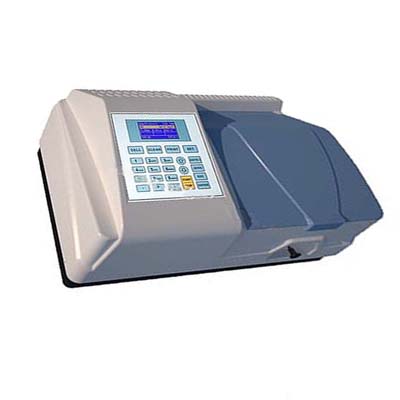
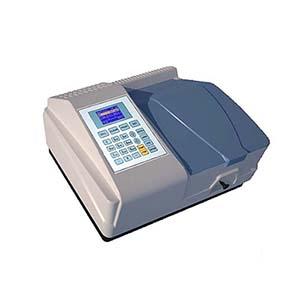
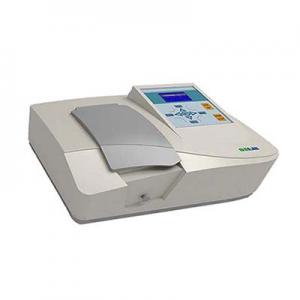
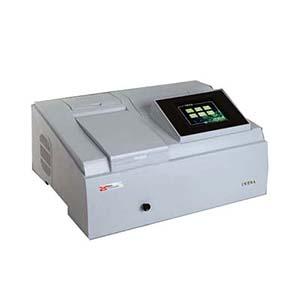
EU-2600A UV-Vis Spectrophotometer
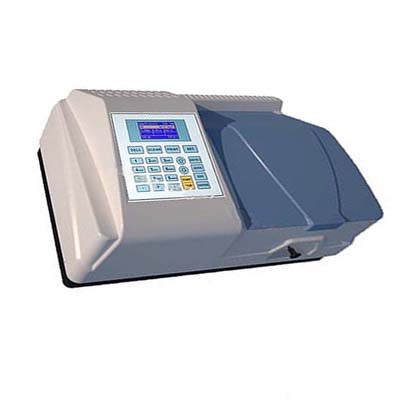
- PRODUCT DETAIL
EU-2600A UV-Vis Spectrophotometer
Product Introduction
The EU-2600A UV-Vis Spectrophotometer is a single-beam analytical instrument designed for ultraviolet and visible light measurement, quantitative analysis, and wavelength scanning. Covering a wavelength range of 190–1100 nm, it supports transmittance, absorbance, energy, and concentration-related analytical workflows.
Equipped with a high-performance 1200 lines/mm diffraction grating, an imported silicon photodiode detector, and long-life tungsten and deuterium lamps, the EU-2600A is designed for accurate and stable optical measurements. Its 2 nm spectral bandwidth, low stray light, and low baseline drift support demanding routine laboratory applications.
The instrument provides standard-curve analysis, data storage, USB and serial interfaces, and optional PC scanning software for expanded data processing, nucleic acid and protein testing, report generation, and wavelength-scan analysis.
Performance Features
• Wide Wavelength Coverage: Measures across 190–1100 nm for UV and visible spectrophotometric applications.
• 2 nm Spectral Bandwidth: Supports wavelength-selective measurements for laboratory analysis.
• Multiple Measurement Modes: Measures transmittance, absorbance, and energy.
• Quantitative Analysis: Supports coefficient-based calculations and standard-curve methods.
• Automatic System Functions: Includes dark current correction and wavelength calibration.
• Low Stray Light: Specified stray light is ≤0.05%T for the EU-2600A.
• Stable Photometric Performance: Baseline drift is specified at ±0.001 A/h.
• Long-Life Light Sources: Uses imported tungsten and deuterium lamps.
• Flexible Data Management: Stores standard curves and test data, retains data when powered off, and supports export to a PC.
• Optional PC Software: Enables wavelength scanning, time scanning, nucleic acid and protein testing, and extended data processing.
• Convenient Operation: Features a 128 × 64 dot-matrix LCD and digital membrane keys.
Working Principle
The EU-2600A uses a single-beam optical system with a high-performance diffraction grating to separate light into specific wavelengths. The selected light passes through the sample, and the silicon photodiode detector measures the transmitted optical signal.
The instrument compares sample measurements with an appropriate reference or blank to determine transmittance and absorbance. Quantitative analysis can then be performed using a coefficient method or a standard calibration curve. With optional PC scanning software, the system can also perform wavelength scans and time-dependent measurements for suitable analytical procedures.
Technical Parameters
|
Parameter |
Specification |
|
Model |
EU-2600A |
|
Optical System |
Single beam |
|
Spectral Bandwidth |
2 nm |
|
Wavelength Range |
190–1100 nm |
|
Wavelength Accuracy |
±0.5 nm |
|
Wavelength Repeatability |
≤0.2 nm |
|
Photometric Range |
0–200%T; −0.3 to 3 A |
|
Photometric Accuracy |
±0.3%T |
|
Photometric Repeatability |
≤0.15%T |
|
Stray Light |
≤0.05%T |
|
Baseline Flatness |
±0.002 A |
|
Baseline Drift / Stability |
±0.001 A/h |
|
Noise |
±0.001 A |
|
Wavelength-Dispersing Element |
High-performance 1200 lines/mm grating |
|
Detector |
Imported silicon photodiode |
|
Light Sources |
Imported long-life tungsten lamp and deuterium lamp |
|
Display |
128 × 64 dot-matrix LCD |
|
Keyboard |
Digital membrane keys |
|
Input/Output Interfaces |
Serial port and USB port |
|
PC Scanning Software |
Optional |
|
Power Supply |
AC 90–250 V, 50/60 Hz |
|
Dimensions |
490 × 390 × 280 mm |
|
Weight |
18 kg |
Application Scenarios
• Chemical Analysis: Measures absorbance and transmittance for suitable chemical samples.
• Pharmaceutical Laboratories: Supports UV-Vis analysis and quantitative testing under applicable methods.
• Biotechnology and Life Sciences: Supports nucleic acid and protein testing when used with compatible software and methods.
• Environmental Testing: Assists with spectrophotometric analysis of water and environmental samples.
• University and Research Laboratories: Supports optical analysis, wavelength scanning, and experimental research.
• Industrial Quality Control: Helps monitor sample composition and product consistency.
• Reaction Kinetics: Supports time-scan analysis through the optional PC software.
EU-2600A vs. EU-2600 UV-Vis Spectrophotometer
|
Parameter |
EU-2600A |
EU-2600 |
|
Optical System |
Single beam |
Single beam |
|
Spectral Bandwidth |
2 nm |
4 nm |
|
Wavelength Range |
190–1100 nm |
190–1100 nm |
|
Wavelength Accuracy |
±0.5 nm |
±0.8 nm |
|
Wavelength Repeatability |
≤0.2 nm |
Not separately specified in the supplied table |
|
Photometric Accuracy |
±0.3%T |
±0.5%T |
|
Photometric Repeatability |
≤0.15%T |
≤0.2%T |
|
Stray Light |
≤0.05%T |
≤0.10%T |
|
Baseline Flatness |
±0.002 A |
±0.003 A |
|
Baseline Drift |
±0.001 A/h |
±0.002 A/h |
|
Noise |
±0.001 A |
±0.001 A |
|
Data Interfaces |
Serial port and USB |
Serial port and USB |
According to the supplied specifications, the EU-2600A offers a narrower spectral bandwidth and improved listed wavelength and photometric performance compared with the EU-2600.
Frequently Asked Questions
1. What is the EU-2600A UV-Vis spectrophotometer used for?
It is used for ultraviolet and visible spectrophotometric measurements, including transmittance, absorbance, energy, quantitative analysis, and wavelength scanning with optional software.
2. What is the wavelength range of the EU-2600A?
The specified wavelength range is 190–1100 nm.
3. What is its spectral bandwidth?
The EU-2600A has a spectral bandwidth of 2 nm.
4. Does the instrument support standard-curve analysis?
Yes. It supports both coefficient-based quantitative analysis and standard-curve methods.
5. Can it perform wavelength and time scanning?
Wavelength scanning and time scanning are listed as functions available through optional PC scanning software. Confirm the required software configuration when ordering.
6. Is the EU-2600A suitable for nucleic acid and protein analysis?
The source lists nucleic acid and protein testing as supported software functions. Suitability for a specific assay depends on the analytical method, accessories, and software configuration.
7. What light sources does the instrument use?
It uses imported long-life tungsten and deuterium lamps to cover its specified wavelength range.
8. How can measurement data be transferred to a computer?
The instrument provides USB and serial interfaces. Optional PC software supports data processing, storage, export, and report generation.
9. What are the instrument's power requirements and dimensions?
It operates on AC 90–250 V at 50/60 Hz. The dimensions are 490 × 390 × 280 mm, and the weight is 18 kg.