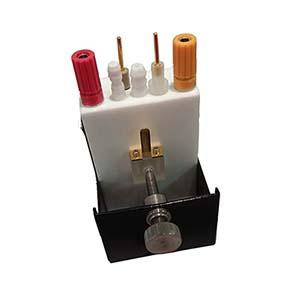
YM011 Coating Evaluation Corrosion Cell

- PRODUCT DETAIL
YM011 Coating Evaluation Corrosion Cell
Product Introduction
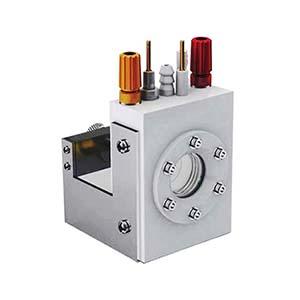
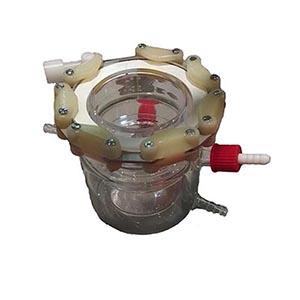
The YM011 Coating Evaluation Corrosion Cell is a laboratory electrochemical testing accessory designed for corrosion evaluation of coated materials. Its glass body and polytetrafluoroethylene (PTFE) lid provide a practical setup for mounting samples and conducting controlled corrosion experiments.
Available in multiple volume configurations and single- or double-layer designs, the YM011 can be selected to suit different experimental requirements. The specified electrode configuration includes a graphite auxiliary electrode and an Ag/AgCl reference electrode, supporting integration into compatible electrochemical test systems.
Performance Features
1. Designed for coating corrosion tests: Suitable for laboratory evaluation of the corrosion behavior of coated samples.
2. Glass cell body: Provides a transparent test vessel for convenient observation of the test solution and experimental setup.
3. PTFE lid: Offers chemical resistance for use with compatible electrolytes and testing conditions.
4. Convenient sample installation: Designed to make sample mounting and setup straightforward.
5. Multiple volume options: Available in nominal volumes from 30 mL to 250 mL to accommodate different test requirements.
6. Single- and double-layer designs: Offers construction options for different experimental configurations.
7. Electrode compatibility: Specified with a graphite auxiliary electrode and an Ag/AgCl reference electrode.
8. Flexible laboratory integration: Can be used with a compatible electrochemical workstation and suitable working-electrode configuration.
Working Principle
The YM011 provides a controlled vessel for electrochemical corrosion testing of coated samples. During a typical experiment, the coated specimen serves as the working electrode and is exposed to a selected electrolyte. A compatible reference electrode provides a reference potential, while the auxiliary electrode completes the electrochemical circuit.
An electrochemical workstation can apply a specified potential or current and measure the resulting response. Depending on the test method, the collected data may help evaluate coating corrosion resistance, electrochemical stability, and coating defects.
The exact electrode arrangement, exposed sample area, electrolyte, and test procedure should be selected according to the coating system and applicable testing standard.
Technical Parameters
|
Parameter |
Specification |
|
Model |
YM011 |
|
Product type |
Coating evaluation corrosion cell |
|
Main application |
Electrochemical corrosion testing of coated materials |
|
Cell body material |
Glass; quartz glass is also mentioned in the supplied description and should be confirmed |
|
Lid material |
Polytetrafluoroethylene (PTFE) |
|
Auxiliary electrode |
Graphite electrode |
|
Reference electrode |
Ag/AgCl electrode |
|
Available volumes |
30 mL, 50 mL, 100 mL, 150 mL, 200 mL, 250 mL |
|
Construction options |
Single-layer and double-layer |
|
Sample installation |
Designed for convenient installation |
|
Compatible equipment |
Electrochemical workstation and suitable electrodes, subject to configuration |
Application Scenarios
• Protective coating evaluation: Investigating the electrochemical corrosion behavior of protective coatings on metal substrates.
• Paint and surface coating research: Supporting laboratory studies of coating performance in selected electrolytes.
• Metal corrosion research: Evaluating corrosion behavior of coated metal specimens under controlled test conditions.
• Electrochemical impedance spectroscopy (EIS): Suitable for compatible cell configurations when the workstation, electrode setup, and sample mounting meet test requirements.
• Coating development and comparison: Comparing electrochemical responses of different coating formulations or surface treatments.
• Materials science laboratories: Supporting research into corrosion mechanisms, coating durability, and electrochemical performance.
YM011 vs. Conventional Corrosion Test Setups
|
Comparison Item |
YM011 Coating Evaluation Corrosion Cell |
General-Purpose Corrosion Test Setup |
|
Intended application |
Coating corrosion evaluation |
Depends on vessel and fixture design |
|
Cell body |
Glass |
Varies by configuration |
|
Lid material |
PTFE |
Varies by configuration |
|
Sample installation |
Designed for convenient sample mounting |
Depends on fixture design |
|
Volume options |
30–250 mL |
Depends on vessel |
|
Construction |
Single- or double-layer options |
Depends on model |
|
Electrode configuration |
Graphite auxiliary and Ag/AgCl reference electrodes specified |
Depends on configuration |
|
System integration |
For use with compatible electrochemical testing equipment |
Depends on equipment and accessories |
Frequently Asked Questions
1. What is the YM011 corrosion cell used for?
It is designed for electrochemical corrosion testing of coated materials, supporting laboratory evaluation of coating behavior in selected electrolytes.
2. What materials are used in the YM011?
The supplied description identifies a glass cell body and a PTFE lid. It also mentions quartz glass, so the exact body material should be confirmed when ordering.
3. What volume options are available?
The listed options are 30 mL, 50 mL, 100 mL, 150 mL, 200 mL, and 250 mL.
4. Which electrodes are specified?
The description specifies a graphite auxiliary electrode and an Ag/AgCl reference electrode. The working electrode is typically the coated sample or a compatible sample holder, depending on the configuration.
5. Is the YM011 available in different structural designs?
Yes. Both single-layer and double-layer versions are listed. Confirm the intended configuration and any temperature-control requirements with the supplier.
6. Can the YM011 be used for electrochemical impedance spectroscopy?
It may be suitable for EIS when paired with a compatible electrochemical workstation and an appropriate electrode arrangement. Confirm compatibility and cell geometry before testing.
7. What should be considered when selecting a cell volume?
Choose a volume that accommodates the specimen, electrodes, and required electrolyte quantity while maintaining the exposed sample area and geometry required by the test method.
8. Is the YM011 compatible with all electrolytes?
Not necessarily. Compatibility depends on the glass material, PTFE components, electrode materials, seals, and test conditions. Verify chemical compatibility with the supplier before use.