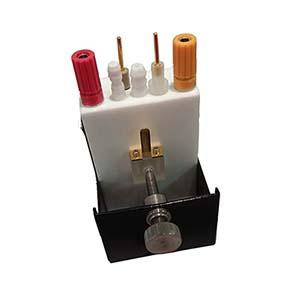
K1000A Photoelectric Chemical Cell

- PRODUCT DETAIL
K1000A Photoelectric Chemical Cell
Product Introduction
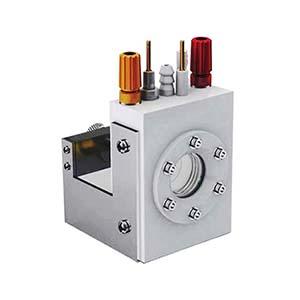
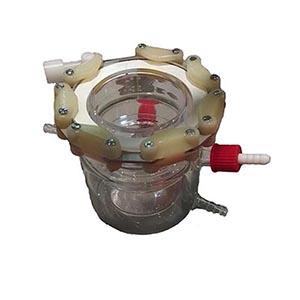
The K1000A Photoelectric Chemical Cell is designed for photoelectrochemical experiments and electrochemical measurements involving ultraviolet and visible light. Its transparent quartz cell body provides optical access to the reaction solution, making it suitable for laboratory research requiring light irradiation and electrochemical analysis.
The cell body material and dimensions can be customized to meet specific experimental requirements. It supports flexible three-electrode configurations and can be equipped with a PTFE lid, a magnetic stirring assembly, and optional gas inlet and gas flow components.
Performance Features
1.High Optical Transparency: Quartz construction provides optical transmittance above 95%, according to the supplied specifications.
2.UV-Visible Light Compatibility: Designed for photoelectrochemical experiments using ultraviolet and visible light.
3. Customizable Design: Cell body material and dimensions can be customized according to experimental requirements.
4.Flexible Three-Electrode Configuration: Supports working, counter, and reference electrodes in different configurations.
5. PTFE Lid: Provides a chemically resistant cover for laboratory applications.
6.Optional Gas Control: An optional gas inlet and gas flow arrangement supports experiments requiring gas introduction.
7. Magnetic Stirring Compatibility: Can be configured with a magnetic stirring assembly to promote solution mixing during experiments.
Working Principle
The K1000A Photoelectric Chemical Cell provides a controlled environment for experiments combining light irradiation and electrochemical reactions. UV or visible light passes through the transparent quartz body and interacts with the sample or photoactive electrode.
The working electrode participates in the electrochemical reaction, while the counter electrode completes the electrical circuit and the reference electrode provides a stable potential reference. An external potentiostat or electrochemical workstation controls the electrode potential and records the resulting current or other electrochemical responses.
Optional magnetic stirring and gas introduction can help meet specific experimental conditions.
Technical Parameters
|
Parameter |
Specification |
|
Model |
K1000A |
|
Product Type |
Photoelectric Chemical Cell |
|
Cell Body Material |
Customizable (OEM) |
|
Cell Body Dimensions |
Customizable (OEM) |
|
Cell Material Optical Transparency |
>95% |
|
Optical Compatibility |
Ultraviolet and visible light |
|
Electrode Configuration |
Working, counter, and reference electrodes |
|
Lid Material |
PTFE |
|
Magnetic Stirring Assembly |
Compatible / configurable |
|
Gas Inlet |
Optional |
|
Gas Flow Function |
Optional |
|
Applications |
Photoelectrochemical and electrochemical experiments |
Note: The supplied specification states a refractive index of zero. This value should be confirmed with the manufacturer, as quartz has a nonzero refractive index. Optical transmittance also depends on wavelength, material thickness, and cell configuration.
Application Scenarios
• Photoelectrochemical Research: Investigating electrochemical responses under UV or visible-light irradiation.
• Photocatalysis Studies: Supporting experiments involving light-driven catalytic processes.
• Solar Energy Research: Evaluating photoactive materials and light-assisted electrochemical reactions.
• Electrode Material Testing: Studying the electrochemical behavior of photoelectrodes and functional materials.
• Gas-Involved Experiments: Supporting research that requires controlled gas introduction into the cell.
• Electrochemical Laboratory Research: Integrating with compatible electrochemical workstations for controlled-potential experiments.
K1000A vs. Conventional Electrochemical Cells
|
Comparison Factor |
K1000A Photoelectric Chemical Cell |
Conventional Electrochemical Cell |
|
Optical Access |
Transparent quartz body |
Depends on cell material |
|
UV-Visible Experiments |
Designed for light-assisted measurements |
Depends on optical accessibility |
|
Cell Dimensions |
Customizable |
Depends on the model |
|
Electrode Configuration |
Flexible three-electrode arrangement |
Depends on the design |
|
Gas Introduction |
Optional gas inlet and flow |
Depends on the configuration |
|
Solution Mixing |
Compatible with magnetic stirring assembly |
Depends on the setup |
|
Lid Material |
PTFE |
Depends on the model |
|
Typical Applications |
Photoelectrochemistry and light-assisted electrochemical research |
General electrochemical testing |
Frequently Asked Questions (FAQ)
1. What is the K1000A Photoelectric Chemical Cell used for?
It is used for photoelectrochemical research, UV-visible light-assisted electrochemical measurements, photocatalysis studies, and photoactive material evaluation.
2. Is the K1000A compatible with ultraviolet and visible light?
Yes. Its transparent quartz cell body is designed for applications involving ultraviolet and visible light. Actual transmission depends on the wavelength and cell specifications.
3. Can the cell dimensions be customized?
Yes. The cell body dimensions can be customized according to the customer's experimental requirements.
4. Which electrodes can be installed?
The cell supports a three-electrode setup consisting of a working electrode, a counter electrode, and a reference electrode. Electrode specifications and mounting arrangements should be confirmed when ordering.
5. Does the K1000A include a PTFE lid?
A PTFE lid is specified for the cell. Please confirm the included accessories and port configuration with the supplier.
6. Can gas be introduced into the cell?
Yes. A gas inlet and gas flow arrangement are available as optional configurations.
7. Is magnetic stirring supported?
Yes. The cell can be configured with a magnetic stirring assembly to facilitate solution mixing during experiments.
8. What is the optical transmittance of the quartz cell?
The supplied specification indicates optical transparency above 95%. The applicable wavelength range and measurement conditions should be confirmed with the manufacturer.