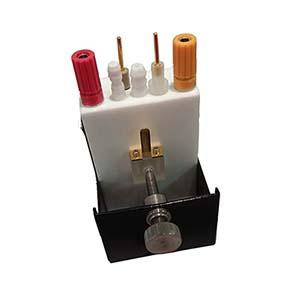
RRDE Rotating Ring-Disk Electrode

- PRODUCT DETAIL
RRDE Rotating Ring-Disk Electrode
Product Introduction
The RRDE Rotating Ring-Disk Electrode is a specialized electrochemical electrode designed for investigating reaction mechanisms, electrode kinetics, and mass transport. By combining a central disk electrode with a surrounding ring electrode, the RRDE enables researchers to analyze electrochemical reactions at the disk while detecting reaction intermediates or products at the ring.
Available with platinum, gold, or glassy carbon electrode materials, the RRDE supports oxygen reduction reaction (ORR), oxygen evolution reaction (OER), fuel cell catalyst evaluation, lithium-air battery research, and corrosion studies. Its externally threaded tip design provides reliable electrical contact and stable signal transmission. Standard disk inner diameters are available in 3 mm, 4 mm, and 5 mm, with custom dimensions available on request.
Performance Features
• Ring-Disk Electrode Configuration: Combines disk and ring electrodes for complementary electrochemical measurements.
• Independent Electrochemical Analysis: Enables simultaneous investigation of disk reactions and collection of electroactive products at the ring.
• Multiple Electrode Materials: Available in platinum, gold, and glassy carbon to suit different experimental requirements.
• Reliable Electrical Contact: External threads on the electrode tip provide secure contact with the ring electrode and support stable signal transmission.
• Insulating Shroud: Typically made from PTFE (Teflon) or PEEK, helping electrically isolate the ring and disk components.
• Multiple Disk Sizes: Standard inner diameters of 3 mm, 4 mm, and 5 mm.
• Customizable Design: Custom dimensions can be requested for specialized electrochemical experiments.
• Versatile Research Applications: Suitable for catalyst development, fuel cell studies, corrosion research, and mass-transport investigations.
Working Principle
The RRDE Rotating Ring-Disk Electrode operates by rotating a disk electrode and a surrounding ring electrode in an electrolyte. The controlled rotation establishes a reproducible hydrodynamic environment and influences the transport of reactants and reaction products near the electrode surface.
An applied potential drives an electrochemical reaction at the disk. Products or intermediates generated at the disk can be transported by the electrolyte flow to the surrounding ring, where they may be detected through a separately controlled ring potential. By analyzing the disk and ring currents and their relationship, researchers can investigate reaction pathways, reaction selectivity, catalytic activity, and mass-transport behavior.
Technical Parameters
|
Parameter |
Specification |
|
Product Name |
RRDE Rotating Ring-Disk Electrode |
|
Product Model |
RRDE |
|
Electrode Configuration |
Central disk with surrounding ring electrode |
|
Available Electrode Materials |
Platinum, gold, glassy carbon |
|
Standard Disk Inner Diameters |
3 mm, 4 mm, 5 mm |
|
Insulating Shroud Materials |
PTFE (Teflon) or PEEK |
|
PEEK Temperature Note |
Specified for use below 100°C |
|
Ring Electrode Contact |
External thread design |
|
Electrical Connection |
Disk core and ring electrode contacts |
|
Dimensions |
Custom dimensions available on request |
|
Main Measurement Applications |
Disk current, ring current, and electrochemical potential measurements |
|
Typical Research Areas |
ORR, OER, catalyst development, fuel cells, lithium-air batteries, corrosion, mass transport |
Note: Rotation speed, ring dimensions, ring-to-disk collection efficiency, electrode area, and connector specifications were not provided and should be confirmed with the manufacturer.
Application Scenarios
• Oxygen Reduction Reaction (ORR): Evaluating oxygen reduction activity and reaction selectivity in electrocatalysts.
• Oxygen Evolution Reaction (OER): Investigating oxygen evolution behavior and electrochemical reaction mechanisms.
• Fuel Cell Research: Characterizing and comparing catalyst performance for hydrogen fuel cells and related electrochemical systems.
• Lithium-Air Battery Research: Studying oxygen-related electrochemical reactions and potential reaction intermediates.
• Electrocatalyst Development: Investigating reaction kinetics, catalytic activity, and product formation.
• Corrosion Research: Studying electrochemical processes and reaction behavior at electrode surfaces.
• Mass Transport Studies: Examining how controlled rotation affects reactant delivery and product transport.
Comparison: RRDE vs. RDE
|
Feature |
RRDE Rotating Ring-Disk Electrode |
RDE Rotating Disk Electrode |
|
Electrode Structure |
Central disk and surrounding ring |
Single disk |
|
Disk Reaction Measurement |
Yes |
Yes |
|
Ring Current Measurement |
Yes |
No |
|
Detection of Disk-Generated Products |
Possible when products are electroactive at the ring |
Not directly through a separate ring |
|
Reaction Mechanism Studies |
Supports additional product and intermediate analysis |
Primarily evaluates disk reaction behavior |
|
Mass Transport Control |
Controlled by rotation |
Controlled by rotation |
|
Typical Applications |
ORR selectivity, catalyst mechanisms, fuel cells, corrosion |
Electrode kinetics, catalyst screening, mass transport |
Frequently Asked Questions
1. What is an RRDE Rotating Ring-Disk Electrode used for?
It is used to investigate electrochemical reaction kinetics, catalytic activity, reaction intermediates, and product selectivity by measuring disk and ring responses.
2. What is the difference between an RRDE and an RDE?
An RRDE has both a disk and a surrounding ring electrode, allowing researchers to monitor disk reactions and detect suitable reaction products at the ring. An RDE has only a disk electrode.
3. Which electrode materials are available?
The available materials include platinum, gold, and glassy carbon. The appropriate material depends on the electrolyte, reaction conditions, and experimental objectives.
4. What standard disk diameters are available?
The specified standard disk inner diameters are 3 mm, 4 mm, and 5 mm. Custom dimensions can be requested.
5. What materials are used for the insulating shroud?
The insulating shroud is typically made from PTFE (Teflon) or PEEK. The supplied specifications indicate that PEEK can be used below 100°C; confirm the complete temperature and chemical compatibility limits before use.
6. How does the ring electrode help analyze electrochemical reactions?
Reaction products or intermediates formed at the disk may be transported to the ring and detected electrochemically when they are sufficiently stable and electroactive under the selected ring potential.
7. Can the RRDE be used for oxygen reduction reaction research?
Yes. RRDE measurements are widely used to study ORR activity and selectivity, including the detection of peroxide-related products under suitable experimental conditions.
8. Is the RRDE suitable for fuel cell catalyst research?
Yes. It supports catalyst characterization and evaluation for hydrogen fuel cells and other electrochemical energy systems.
9. Can custom RRDE dimensions be supplied?
Yes. Custom dimensions are available on request. Contact the manufacturer to confirm ring and disk geometry, connection compatibility, and other experimental requirements.