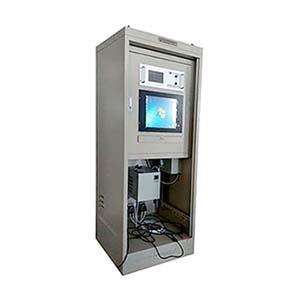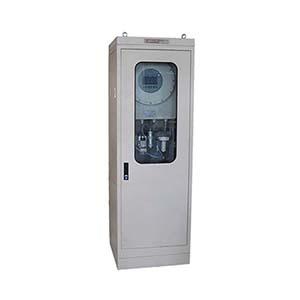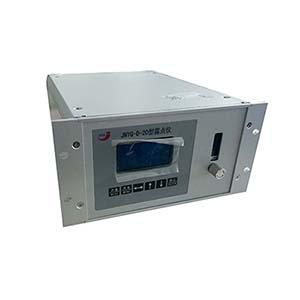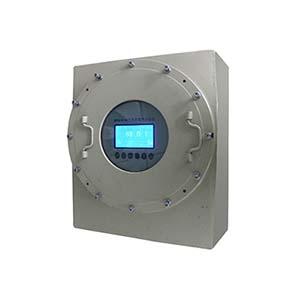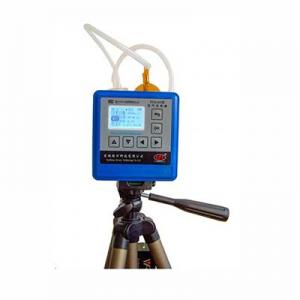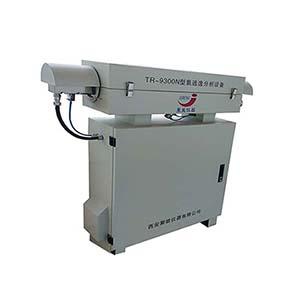
JNYQ-O-15 Laser Gas Analyzer

- PRODUCT DETAIL
JNYQ-O-15 Laser Gas Analyzer
Product Introduction
The
JNYQ-O-15 Laser Gas Analyzer is an industrial process gas analyzer based on
Tunable Diode Laser Absorption Spectroscopy (TDLAS). It provides fast,
selective measurement of target gases, including CO, CO₂, O₂, H₂S, HCl, and HF. Featuring non-contact optical measurement,
high sensitivity, and a response time of ≤1 second, it supports real-time
process monitoring under demanding industrial conditions.
Its
compact integrated structure, modular design, and lack of a conventional sample
gas pretreatment system help simplify installation and reduce maintenance
requirements.
Performance Features
• High Selectivity: Minimizes
cross-interference from background gases.
• Fast Response: T90 response time of
≤1 second for timely process control.
•Harsh-Environment
Capability: Designed for demanding industrial applications, including
coke-related processes.
• Dust and Window
Contamination Resistance: Designed to minimize measurement interference
from dust and optical window contamination.
• Stable Measurement: Reduced
sensitivity to changes in measured gas environmental parameters.
• Low Maintenance: Direct process gas
measurement eliminates the need for a conventional sampling pretreatment
system.
• Modular Construction: Functional
modules, including laser modules, can be replaced on-site.
• Integrated Design: Compact
structure and high reliability simplify system integration.
• Environmental
Protection: No sample gas discharge during normal measurement.
• Intelligent Operation: Designed
for convenient operation, maintenance, and process integration.
Working Principle
The
JNYQ-O-15 uses Tunable Diode Laser Absorption Spectroscopy (TDLAS). A tunable
diode laser emits light at a wavelength selected for the target gas's
characteristic absorption line. As the laser passes through the process gas,
the target molecules absorb part of the light.
The
analyzer measures the absorption signal and uses it to determine gas
concentration. This optical method provides selective, rapid measurement
without extracting a conventional gas sample, supporting continuous process
monitoring and control.
Technical Parameters
Parameter
Specification
Model
JNYQ-O-15
Measurement
Principle
Tunable
Diode Laser Absorption Spectroscopy (TDLAS)
Monitoring
Components
CO,
CO₂, O₂, H₂S, HCl, HF, etc.
Measurement
Range
Customized
according to customer requirements
Linearity
Error
≤
±1% F.S. over six months
Range
Drift
≤
±1% F.S. over six months
Repeatability
<
1%
Explosion-Proof
Rating
Ex
d IIC T6 Gb
Protection
Rating
IP66
Warm-Up
Time
≤
15 min
Response
Time (T90)
≤
1 s
Analog
Output
2
× 4–20 mA, isolated; maximum load 750 Ω
Relay
Output
3
outputs; 24 V, 1 A
Analog
Input
2
× 4–20 mA for temperature and pressure compensation
Communication
Interfaces
RS485,
RS232, GPRS
Power
Supply
24
VDC (18–36 VDC)
Power
Consumption
<
10 W
Operating
Temperature
−30
to 60°C
Storage
Temperature
−40
to 80°C
Purge
Gas Pressure
0.3–0.8
MPa
Purge
Gas
Industrial
nitrogen or purified instrument gas
Application Scenarios
• Metallurgical Industry: Monitoring
process gases in steelmaking, ironmaking, and coke-related operations.
• Chemical Industry: Monitoring
target gas concentrations in chemical production processes.
• Environmental
Monitoring: Supporting process emission monitoring and pollution
control.
• Industrial
Combustion: Monitoring combustion-related gases for process
optimization.
• Industrial Safety: Monitoring
selected hazardous or corrosive gases, subject to the configured measurement
range and application requirements.
• Process Automation: Providing
real-time gas concentration signals to distributed control systems (DCS) and
programmable logic controllers (PLCs).
JNYQ-O-15 vs. Conventional Gas Analyzers
Comparison Item
JNYQ-O-15 Laser Gas Analyzer
Conventional Extractive Gas Analyzer
Measurement
Method
Direct
optical measurement
Typically
extracts and conditions a gas sample
Response
Time
T90
≤ 1 s
Depends
on sampling and analyzer configuration
Background
Gas Interference
High
selectivity for configured target gases
Depends
on sensing technology
Sample
Pretreatment
Not
required for the standard direct-measurement configuration
Often
required
Maintenance
Requirements
Reduced
sampling-system maintenance
May
require maintenance of pumps, filters, and sampling lines
Gas
Discharge
No
sample gas discharge during normal measurement
May
discharge extracted sample gas
System
Design
Compact,
integrated, modular
Depends
on sampling and analyzer configuration
Industrial
Protection
IP66,
Ex d IIC T6 Gb
Depends
on the selected model
Frequently Asked Questions (FAQ)
Q1: What gases can the
JNYQ-O-15 measure?
It can be configured to
monitor gases such as CO, CO₂, O₂, H₂S,
HCl, and HF. Available components depend on the application configuration.
Q2: What is the
measurement principle of the JNYQ-O-15?
It uses Tunable Diode
Laser Absorption Spectroscopy (TDLAS) to measure gas concentration through the
characteristic absorption of laser light by target gas molecules.
Q3: How fast does the
analyzer respond?
The specified T90
response time is ≤1 second, supporting rapid process monitoring and control.
Q4: Does the analyzer
require a gas sampling pretreatment system?
The analyzer is
designed for direct process gas measurement without a conventional sampling
pretreatment system, simplifying installation and maintenance.
Q5: Can the JNYQ-O-15
operate in harsh industrial environments?
It is designed for
demanding industrial conditions and has an IP66 protection rating. The
permitted operating temperature is −30 to 60°C. Final suitability depends on
the specific process conditions and installation arrangement.
Q6: Is the analyzer
suitable for hazardous areas?
The specified
explosion-proof rating is Ex d IIC T6 Gb. The installation must comply with the
applicable hazardous-area classification and local safety requirements.
Q7: What communication
and output options are available?
The analyzer provides
two isolated 4–20 mA analog outputs, three relay outputs, two 4–20 mA analog
inputs, and RS485, RS232, and GPRS communication interfaces.
Q8: Is the measurement
range customizable?
Yes. The measurement
range is determined according to customer requirements and the target gas
application.
Q9: What purge gas is
required?
Industrial nitrogen or
purified instrument gas can be used at a specified pressure of 0.3–0.8 MPa,
subject to the installation requirements.