JNYQ-H30 Thermal Conductivity Hydrogen H₂ Analyzer

- PRODUCT DETAIL
JNYQ-H30 Thermal Conductivity Hydrogen H₂ Analyzer
Product Introduction
The JNYQ-H30 Thermal Conductivity Hydrogen Analyzer is designed for continuous, automatic measurement of hydrogen concentration in mixed gases. Using thermal conductivity detection technology, it provides digital measurement and signal processing for industrial gas analysis.
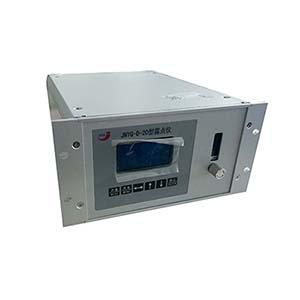
Featuring a compact 3U chassis, digital temperature compensation, and standard signal output, the JNYQ-H30 hydrogen analyzer is suitable for installation in complete equipment systems or use in laboratories. Its simple structure and low maintenance requirements make it suitable for non-explosion-hazardous environments, including thermal power plants, fertilizer plants, research institutes, and testing laboratories.
Performance Features
1.Continuous Hydrogen Monitoring: Automatically measures hydrogen concentration in mixed gases for ongoing process monitoring.
2.Thermal Conductivity Detection: Uses a thermal element-based measurement system to determine hydrogen concentration.
3.Compact 3U Chassis: Standard 270 mm-wide, 3U-format housing for equipment integration and laboratory installation.
4. Digital Temperature Compensation: Adaptive temperature control and digital compensation help improve measurement stability.
5. Single-Bridge Measuring Circuit: Incorporates a single-bridge circuit and compensation gas arrangement.
6. Digital Signal Processing: Processes measurement signals and provides a linearized concentration output.
7. Multiple Signal Interfaces: Provides a 4–20 mA analog output and an RS-232 communication interface.
8. Low Maintenance Design: A simple structure supports routine maintenance and long-term operation.
Working Principle
The JNYQ-H30 hydrogen analyzer operates on the principle of thermal conductivity measurement. Hydrogen has a thermal conductivity that differs significantly from that of many other gases. The instrument detects changes in heat transfer from a thermal element as the composition of the mixed gas changes.
The measuring circuit converts these changes into an electrical signal. Digital signal processing and temperature compensation are then applied to calculate and output the hydrogen concentration. The analyzer provides a linearized measurement signal for continuous monitoring and connection to compatible control or data acquisition systems.
Note: Measurement accuracy depends on gas composition, calibration, operating conditions, and the presence of other gases that may affect thermal conductivity.
Technical Parameters
|
Parameter |
Specification |
|
Model |
JNYQ-H30 |
|
Measurement Principle |
Thermal conductivity |
|
Measured Component |
Hydrogen (H₂) |
|
Detection Range |
0.00–99.99% (range optional) |
|
Accuracy |
≤ ±1% FS |
|
Resolution |
0.01% |
|
Zero Drift |
≤ ±1% FS / 7 days |
|
Span Drift |
≤ ±1% FS / 7 days |
|
Repeatability |
≤ ±1% |
|
Warm-Up Time |
≤ 30 minutes |
|
Response Time |
T90 ≤ 15 seconds |
|
Analog Output |
4–20 mA |
|
Communication Interface |
RS-232 |
|
Contact Capacity |
220 VAC, 1 A; 24 VDC, 1 A |
|
Operating Temperature |
−10°C to +45°C |
|
Operating Humidity |
≤ 90% RH |
|
Power Supply |
220 VAC ±10%, 50 Hz ±5% |
|
Overall Dimensions |
270 × 135 × 310 mm (W × H × D) |
|
Mounting Dimensions |
214 × 133 mm (W × H) |
|
Weight |
Approximately 3.8 kg |
|
Installation |
Panel or equipment integration; laboratory use |
|
Installation Environment |
Non-explosion-hazardous areas |
Application Scenarios
• Thermal Power Plants: Continuous hydrogen concentration monitoring in applicable gas analysis processes.
• Fertilizer Plants: Hydrogen measurement in industrial mixed-gas streams.
• Industrial Gas Systems: Monitoring hydrogen concentration where thermal conductivity analysis is suitable.
• Laboratory Testing: Hydrogen concentration analysis for research and experimental applications.
• Research Institutes: Gas composition studies and process-related experimental work.
• Equipment Integration: Installation in compatible industrial equipment and gas monitoring systems.
JNYQ-H30 Hydrogen Analyzer vs. General Gas Analysis Methods
|
Comparison Item |
JNYQ-H30 Thermal Conductivity Analyzer |
General Gas Analysis Instruments |
|
Measurement Principle |
Thermal conductivity |
Depends on the selected technology |
|
Hydrogen Measurement |
Designed for hydrogen concentration in mixed gases |
Depends on sensor type and configuration |
|
Measurement Mode |
Continuous, automatic measurement |
May be continuous or intermittent |
|
Temperature Compensation |
Digital temperature compensation |
Depends on instrument design |
|
Analog Signal |
4–20 mA |
Depends on model |
|
Communication |
RS-232 |
Depends on model |
|
Installation |
Compact 3U chassis |
Varies by instrument |
|
Best Selection Criteria |
Suitable gas composition, range, and process requirements |
Application-specific performance and compatibility |
Frequently Asked Questions
1. What is the JNYQ-H30 hydrogen analyzer used for?
It is used for continuous, automatic measurement of hydrogen concentration in mixed gases, particularly in industrial process monitoring and laboratory applications.
2. What is the measurement range of the JNYQ-H30?
The specified detection range is 0.00–99.99%, with the measurement range selectable according to requirements.
3. How does the thermal conductivity hydrogen analyzer work?
It measures changes in heat transfer associated with the thermal conductivity of the gas mixture and converts these changes into a hydrogen concentration reading.
4. What is the measurement accuracy?
The specified accuracy is ≤ ±1% of full scale (FS), with a resolution of 0.01%. Actual performance depends on calibration and gas composition.
5. How quickly does the analyzer respond?
The specified T90 response time is no more than 15 seconds. The warm-up time is up to 30 minutes.
6. What output signals are available?
The analyzer provides a 4–20 mA analog output and an RS-232 communication interface. Its contact capacity is 220 VAC at 1 A or 24 VDC at 1 A.
7. Can the JNYQ-H30 be integrated into industrial equipment?
Yes. Its compact 3U chassis is designed for integration into compatible equipment systems and can also be used in laboratories.
8. Is the JNYQ-H30 suitable for hazardous or explosive areas?
The supplied specifications identify it for non-explosion-hazardous environments. It should not be installed in an explosive atmosphere unless the specific model has the required certified protection.
9. What should be considered when selecting a thermal conductivity hydrogen analyzer?
Confirm the required concentration range, gas matrix, possible interfering gases, operating conditions, output requirements, and calibration method. Thermal conductivity measurements may be affected by changes in the composition of gases other than hydrogen.

NEXT:JNYQ-H-91 Industrial Hydrogen Analyzer