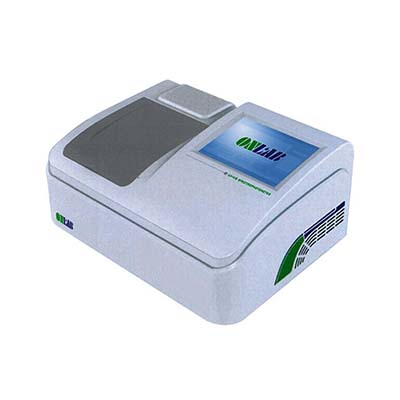
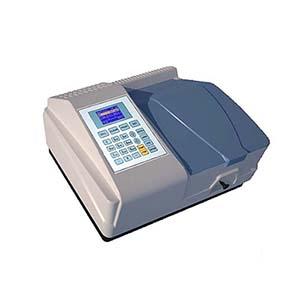
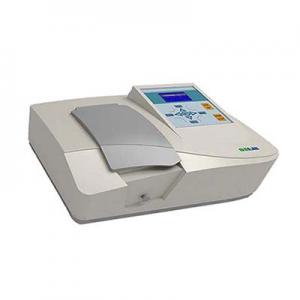
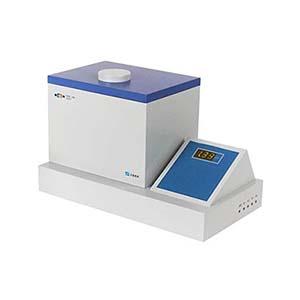
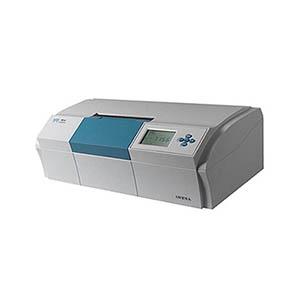
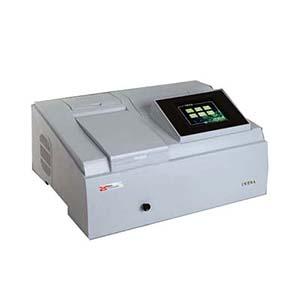
EV-2600RT Split Beam UV/VIS Spectrophotometer
- PRODUCT DETAIL
EV-2600RT Split Beam UV/VIS Spectrophotometer
Product Introduction
The
EV-2600RT Split Beam UV/VIS Spectrophotometer is a laboratory analytical
instrument designed for reliable qualitative and quantitative spectral
analysis. Its split-beam ratio-monitoring optical system helps minimize
measurement drift, making it suitable for long-duration testing and routine
quality control. Covering a wavelength range of 320–1100 nm with a 2.0 nm
spectral bandwidth, the instrument supports absorbance, transmittance, and
concentration measurements. A 9.7-inch color touchscreen provides intuitive
operation and curve display, while automatic wavelength setting, blank
measurement, and real-time data storage improve workflow efficiency. Optional
PC scanning software enables wavelength scanning and expanded spectral analysis
for universities, research institutions, and industrial laboratories.
Performance Features
• Split-Beam Ratio
Monitoring: Helps compensate for optical fluctuations and reduce
measurement drift during extended testing.
• Wide
Wavelength Range: Covers 320–1100 nm for visible and
near-infrared spectrophotometric applications.
• Low
Noise and Stray Light: Supports dependable optical measurements and
routine quantitative analysis.
• 9.7-Inch
Color Touchscreen: Provides an intuitive interface for instrument
operation, result viewing, and spectral curve display.
• Automatic
Wavelength Setting: Offers automatic wavelength adjustment with
0.1 nm resolution and automatic blanking.
• Flexible Curve Fitting: Supports
standard curve fitting using single- or dual-wavelength methods.
• Real-Time
Data Storage: Saves measurement data and curves for convenient review
and reporting.
• High-Quality
Optical Components: Uses a 1200-lines/mm blazed holographic
grating, silicon photodiode detector, and pre-aligned tungsten and deuterium
lamps.
• Convenient
Lamp Maintenance: Individual lamp switching and pre-aligned lamp
replacement simplify routine maintenance.
• Optional PC Scanning: Supports
wavelength scanning through optional PC software.
• Durable
Construction: A reinforced baseboard and bracket provide structural
stability for laboratory operation.
Working Principle
The
EV-2600RT operates on the principle of UV-Visible spectrophotometry using a
split-beam ratio-monitoring optical system. Light from the tungsten or
deuterium lamp passes through a monochromator equipped with a blazed
holographic grating, which selects the required wavelength. The optical system
monitors the light intensity ratio to help compensate for fluctuations and
improve measurement stability. A silicon photodiode detects the transmitted
light, and the instrument processes the measured signals to calculate
absorbance, transmittance, or concentration. The resulting data can be
displayed on the touchscreen and used for quantitative analysis, standard curve
fitting, and spectral evaluation.
Technical Parameters
Parameter
Specification
Model
EV-2600RT
Wavelength
Range
320–1100
nm
Spectral
Bandwidth
2.0
nm
Optical
System
Split-beam
ratio monitoring; blazed holographic grating, 1200 lines/mm
Wavelength
Accuracy
±0.5
nm
Wavelength
Repeatability
≤0.2
nm
Wavelength
Setting
Automatic;
0.1 nm resolution
Photometric
Range
0–200%T,
−0.3–3 A, 0–9999 C
Photometric
Accuracy
±0.002
A (0–0.5 A); ±0.003 A (0.5–1 A); ±0.3%T (0–100%T)
Photometric
Repeatability
≤0.001
A (0–0.5 A); ≤0.002 A (0.5–1 A); ≤0.2%T (0–100%T)
Stray
Light
≤0.05%T
at 220/360 nm
Scan
Speed
High,
medium, low; maximum 2000 nm/min
Baseline
Flatness
±0.002
A
Stability
±0.002
A/h at 500 nm, 0 A
Noise
≤0.2%T/3
min at 250/500 nm, 0%T; ≤0.5%T/3 min at 250/500 nm, 100%T
Sample
Compartment
Accommodates
cuvettes with 5–100 mm path lengths
Detector
Silicon
photodiode
Light
Sources
Pre-aligned
tungsten lamp and deuterium lamp
Display
9.7-inch
color touchscreen
Data
Storage
Real-time
data and curve storage
PC
Software
Optional
PC scanning software
Application Scenarios
• University
and Research Laboratories: Supports spectroscopy experiments,
quantitative analysis, and scientific research.
• Quality Control
Laboratories: Enables routine absorbance, transmittance, and
concentration testing.
• Chemical
Analysis: Assists with quantitative determination of suitable light-absorbing compounds.
• Pharmaceutical
Testing: Supports spectrophotometric analysis of compatible raw materials and
formulations.
• Environmental
Testing: Facilitates analysis of suitable water and environmental samples using
validated UV-Visible methods.
• Industrial
Laboratories: Provides optical measurement capabilities for raw material
inspection and product quality control.
• Long-Duration
Testing: The ratio-monitoring optical system helps maintain stable measurements during
extended analytical procedures.
EV-2600RT vs. Conventional Single-Beam UV/VIS
Spectrophotometers
Comparison Item
EV-2600RT Split Beam
Conventional Single Beam
Optical
Configuration
Split-beam
ratio-monitoring system
Single-beam
optical system
Drift
Compensation
Monitors
light intensity ratios to help reduce drift
More
dependent on measurement timing and instrument stability
Wavelength
Range
320–1100
nm
Depends
on model
Spectral
Bandwidth
2.0
nm
Depends
on model
Wavelength
Accuracy
±0.5
nm
Depends
on model
Display
9.7-inch
color touchscreen
Depends
on model
Automatic
Wavelength Setting
Supported
Depends
on model
Curve
Fitting
Single-
or dual-wavelength standard curve fitting
Depends
on model
Data
Storage
Real-time
data and curve storage
Depends
on model
Typical
Applications
Extended
testing, research, and routine quality control
General
laboratory and routine analytical testing
Note: This comparison reflects general optical system
differences. Actual performance depends on the instrument model and operating
conditions.
Frequently Asked Questions
1. What is the EV-2600RT Split Beam UV/VIS
Spectrophotometer used for?
It
is designed for qualitative and quantitative spectrophotometric analysis,
including absorbance, transmittance, concentration determination, and standard
curve fitting.
2. What is the wavelength range of the EV-2600RT?
The
instrument covers 320–1100 nm, supporting measurements in the visible and
near-infrared regions.
3. What is the advantage of the split-beam ratio-monitoring
optical system?
It
monitors light intensity ratios to help compensate for optical fluctuations and
reduce measurement drift, making it suitable for long-duration testing.
4. Does the EV-2600RT have a touchscreen?
Yes.
It features a 9.7-inch color touchscreen for instrument control, measurement
result display, and spectral curve viewing.
5. What is the spectral bandwidth of the EV-2600RT?
The
specified spectral bandwidth is 2.0 nm.
6. Can the EV-2600RT perform quantitative analysis?
Yes.
It supports absorbance, transmittance, concentration readings, and standard
curve fitting using single- or dual-wavelength methods.
7. Does the instrument support wavelength scanning?
Yes.
Wavelength scanning is available through optional PC scanning software.
8. Which lamps are used in the EV-2600RT?
The
instrument uses pre-aligned tungsten and deuterium lamps. Each lamp can be
switched on or off independently, and the pre-aligned design simplifies
replacement.
9. What cuvette sizes can the EV-2600RT accommodate?
The
sample compartment accommodates cuvettes with optical path lengths from 5 to
100 mm, allowing different sample configurations for laboratory analysis.