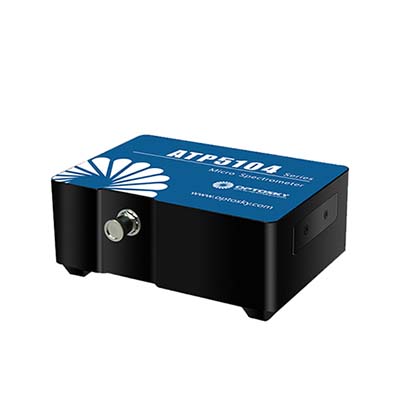
ATP5034 Cooling 4096-Pixel Ultra-High-Resolution Fiber Spectrometer
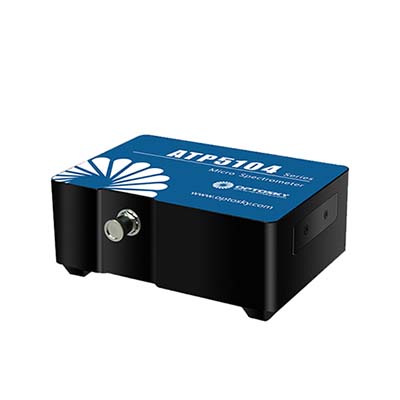
- PRODUCT DETAIL
ATP5034 Cooling 4096-Pixel Ultra-High-Resolution Fiber
Spectrometer
Product Introduction
The
ATP5034 Cooling 4096-Pixel Ultra-High-Resolution Fiber Spectrometer is a
compact optical analysis instrument designed for demanding high-resolution
spectral measurement, laboratory research, and online monitoring applications.
The ATP5030/4 series is available with a cooled 2048- or 4096-pixel linear
array detector, providing configuration options for different spectral
resolution and measurement requirements.
Its
thermoelectric cooling (TEC) system maintains the detector at a specified
temperature of −5°C, helping reduce dark current and detector noise while
improving signal quality. With a broad 200–1100 nm wavelength range, USB Type-C
data output, and adjustable integration times from 0.1 ms to 256 seconds, the
spectrometer supports flexible integration into analytical instruments and
industrial measurement systems.
The
ATP5034 uses a Czerny–Turner optical design and offers selectable entrance slit
widths. Its compact 150 × 90 × 37.5 mm enclosure and 0.5 kg weight make it
suitable for space-constrained installations, including customized OEM systems
and online optical testing equipment.
Performance Features
• TEC-Cooled Detector: Cools the
detector to −5°C to help reduce dark current and improve measurement stability.
• 4096-Pixel Detector
Option: Available with a 2048- or 4096-pixel linear array detector, depending on
configuration.
• Broad Spectral Range: Covers
200–1100 nm for ultraviolet-edge, visible, and near-infrared spectral
applications.
• High
Spectral Resolution: Supports high-resolution configurations, with
a stated series-level resolution range of 0.05–2 nm; the detailed optical
specification lists 0.07–3 nm, depending on configuration.
• Low-Light Measurement
Support: Detector cooling and low-noise electronics help improve spectral acquisition
under suitable measurement conditions.
• Wide Integration Time
Range: Adjustable from 0.1 ms to 256 seconds to accommodate different signal
intensities.
• High-Speed Data
Acquisition: Features a 16-bit ADC with a specified 2 MHz sampling
rate.
• Low Stray Light: Specified
stray-light levels are below 0.05% at 600 nm and below 0.09% at 435 nm.
• Flexible
Optical Coupling: Uses an SMA905 fiber connector and offers
optional entrance slit widths.
• Built-In Trigger
Control: Includes a synchronous trigger control circuit for a xenon lamp.
• Compact
Integration: Measures 150 × 90 × 37.5 mm and weighs approximately 0.5
kg.
• USB Type-C
Connectivity: Provides a convenient digital interface for data transfer
and system integration.
Working Principle
The
ATP5034 uses a grating-based Czerny–Turner optical system to separate incoming
light into its constituent wavelengths. Light enters through the SMA905 fiber
connector and entrance slit, then passes through the optical path, where it is
collimated, dispersed by a diffraction grating, and focused onto the linear
array detector.
The
detector converts wavelength-dependent light intensity into electrical signals.
Its thermoelectric cooling system maintains a specified detector temperature of
−5°C, helping reduce dark current and noise. The 16-bit analog-to-digital
converter digitizes the detector output, and the resulting spectral data are
transferred through USB Type-C for processing and analysis.
Users
can adjust integration time to balance signal strength and acquisition speed.
Detector pixel count, slit width, and other optical configuration choices
affect the achievable spectral resolution and overall measurement performance.
Technical Parameters
Parameter
Specification
Model
ATP5034
/ ATP5030/4 series
Product
Type
TEC-Cooled
Ultra-High-Resolution Fiber Spectrometer
Detector
Type
Linear
array detector
Effective
Pixels
2048
or 4096, depending on configuration
Detector
Cooling
TEC,
−5°C
Pixel
Dimensions
14
μm × 200 μm
Detector
Sensitivity
1300
V/(lx·s)
Dark
Noise
13
RMS at 13°C (as supplied; confirm test conditions)
Spectral
Range
200–1100
nm
Optical
Resolution
0.07–3
nm in detailed specifications; series introduction also states 0.05–2 nm
Signal-to-Noise
Ratio
>600:1
Dynamic
Range
8.5
× 10⁷ (system); 2000:1 for a single acquisition
Stray
Light
<0.05%
at 600 nm; <0.09% at 435 nm
Optical
Design
Czerny–Turner
(C-T)
Focal
Length
75
mm
Standard
Entrance Slit
50
μm
Optional
Entrance Slits
10,
25, 100 μm
Incident
Optical Interface
SMA905
connector
Integration
Time
0.1
ms–256 s
ADC
Resolution
16
bit
ADC
Sampling Rate
2
MHz
Data
Interface
USB
Type-C
Power
Supply
DC
4.5–5.5 V (typically 5 V)
Operating
Current
170
mA typical
Operating
Temperature
−25°C
to +50°C
Storage
Temperature
−30°C
to +70°C
Operating
Humidity
<90%
RH
Dimensions
150
× 90 × 37.5 mm
Weight
0.5
kg
Sealing
Anti-sweat
Additional
Feature
Built-in
synchronous xenon lamp trigger control circuit
Specification note: The supplied information gives
different resolution ranges in the series introduction and detailed parameter
table. Actual resolution depends on detector configuration, wavelength range,
and slit width. Confirm the selected model's final specifications with the
supplier.
Application Scenarios
• High-Resolution
Spectroscopy: Spectral measurements requiring detailed wavelength
discrimination.
• UV-Visible-NIR
Analysis: Optical measurements across a broad wavelength range from 200 to 1100 nm.
• Online Optical
Monitoring: Integration into compatible industrial systems for
continuous or periodic spectral measurements.
• Scientific Research: Laboratory
studies involving optical materials, spectral characteristics, and light-source
analysis.
• Chemical
and Material Analysis: Spectral characterization of suitable samples
and materials.
• Low-Light Spectroscopy: Applications that benefit from detector cooling and reduced dark-current
contributions.
• OEM
Instrument Development: Integration into customized analytical
instruments and optical measurement platforms.
• Xenon-Lamp-Based
Systems: Applications that use synchronized triggering with compatible xenon light
sources.
ATP5034 vs. Conventional Uncooled Fiber Spectrometers
Comparison Item
ATP5034 Cooled Fiber Spectrometer
Conventional Uncooled Fiber Spectrometer
Detector
Cooling
TEC
cooling to −5°C
Typically
operates without active cooling
Detector
Options
2048
or 4096 pixels
Depends
on model
Spectral
Range
200–1100
nm
Depends
on detector and optics
Spectral
Resolution
Configuration-dependent;
detailed specification states 0.07–3 nm
Depends
on optical design
Dark
Current Control
Cooling
helps reduce dark current
Depends
on detector temperature and design
Integration
Time
0.1
ms–256 s
Depends
on model
ADC
Resolution
16
bit
Depends
on model
Data
Interface
USB
Type-C
Varies
by model
Optical
Input
SMA905
fiber connector
Varies
by configuration
Typical
Applications
High-resolution
analysis and online monitoring
General-purpose
spectral measurement
Note: The comparison is general. Actual performance depends
on the detector, optical configuration, operating conditions, and measurement
setup.
Frequently Asked Questions
Q1: What is the ATP5034 fiber spectrometer used for?
It
is designed for high-resolution optical spectroscopy, UV-visible-NIR analysis,
online monitoring, laboratory research, and integration into OEM analytical
instruments.
Q2: What is the detector cooling temperature?
The
specified TEC cooling temperature is −5°C. Cooling helps reduce detector dark
current and noise, although actual performance depends on operating conditions.
Q3: Does the ATP5034 support a 4096-pixel detector?
Yes.
The ATP5030/4 series is specified with 2048- or 4096-pixel detector options.
Confirm the detector configuration when ordering the ATP5034 model.
Q4: What wavelength range can the spectrometer measure?
Its
specified spectral range is 200–1100 nm, supporting a variety of UV, visible,
and near-infrared applications.
Q5: What spectral resolution does the ATP5034 provide?
The
detailed technical parameters list 0.07–3 nm, while the series introduction
states 0.05–2 nm. The actual resolution depends on the selected detector, slit
width, wavelength range, and optical configuration, so the required
configuration should be confirmed with the supplier.
Q6: What is the integration time range?
The
integration time is adjustable from 0.1 ms to 256 seconds, enabling
measurements under different light levels and acquisition-speed requirements.
Q7: Which optical input and data interfaces are supported?
The
instrument uses an SMA905 fiber connector for optical input and USB Type-C for
data output.
Q8: What power supply does the spectrometer require?
It
operates on DC 4.5–5.5 V, typically 5 V, with a specified typical operating
current of 170 mA.
Q9: Can the ATP5034 be used for online testing?
Yes.
Its compact design, USB Type-C interface, and flexible integration settings
make it suitable for compatible online optical measurement systems. The final
setup depends on the required sampling arrangement, software, and environmental
conditions.