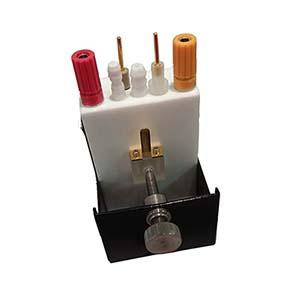
RDE1 PEEK-Shrouded Rotating Disk Electrode with a Shaft

- PRODUCT DETAIL
Product Introduction
The RDE1 PEEK-Shrouded Rotating Disk Electrode is an electrochemical research electrode designed for controlled electrochemical measurements and hydrodynamic studies. Consisting of an electrode tip and a shaft, it provides a practical configuration for experiments that require controlled rotation of the electrode surface in an electrolyte.
The electrode tip typically features a PEEK insulating shroud surrounding the electrode material, while the exposed disk surface is polished to a mirror-like finish. Threaded connections and a dedicated metal contact area on the shaft provide electrical contact with the disk electrode.
By rotating at a controlled speed, the RDE1 helps regulate mass transport between the electrolyte and the electrode surface. This makes it suitable for corrosion studies, electrocatalyst evaluation, fuel cell research, and investigations of electrochemical reaction kinetics.
Performance Features
• PEEK Insulating Shroud: Provides electrical insulation around the electrode tip while exposing the active disk surface to the electrolyte.
• Mirror-Polished Electrode Surface: A smooth working surface supports reproducible electrochemical measurements and consistent contact with the electrolyte.
• Integrated Shaft Design: The electrode consists of a removable or replaceable tip and a shaft, depending on the specific configuration.
• Threaded Electrical Connections: Threads on the shaft and inside the electrode tip are designed to establish electrical contact with the disk.
• Dedicated Metal Contact Area: A conductive contact area on the shaft provides an electrical connection to the disk electrode.
• Controlled Hydrodynamic Conditions: Rotation helps regulate reactant transport to the electrode surface and supports studies of diffusion-controlled electrochemical processes.
• Broad Research Applications: Suitable for electrochemical testing, corrosion analysis, catalyst development, fuel cell research, and reaction-kinetics investigations.
Working Principle
The RDE1 rotating disk electrode operates by rotating a conductive disk electrode at a controlled speed while it is immersed in an electrolyte.
1. Electrochemical Connection: The disk electrode is electrically connected to the potentiostat through the conductive shaft and contact area.
2. Surface Insulation: The PEEK shroud electrically insulates the surrounding electrode structure, leaving the disk surface exposed to the electrolyte.
3. Controlled Rotation: Rotation creates a defined hydrodynamic flow near the disk surface.
4. Mass Transport Regulation: The rotating flow transports electroactive species toward the electrode and carries reaction products away from the surface.
5. Electrochemical Measurement: The resulting current or potential response is measured to investigate reaction kinetics, diffusion behavior, corrosion processes, and catalyst performance.
The controlled transport conditions provided by a rotating disk electrode can help researchers distinguish kinetic effects from mass-transfer limitations. Actual performance depends on the electrode material, disk dimensions, rotation speed, electrolyte, and experimental setup.
Structural Components
|
Component |
Description |
Function |
|
Electrode Tip |
Contains the disk electrode and surrounding insulation |
Provides the working electrode surface |
|
PEEK Insulating Shroud |
Insulating material surrounding the disk |
Electrically isolates the sides of the electrode |
|
Polished Disk Surface |
Exposed conductive electrode surface |
Interfaces with the electrolyte for electrochemical reactions |
|
Shaft Threads |
Threaded connection normally in electrical contact with the disk |
Supports connection between the shaft and electrode tip |
|
Internal Tip Threads |
Threads inside the electrode tip that normally contact the disk electrically |
Establish electrical continuity within the assembly |
|
Metal Contact Area |
Conductive metal area on the shaft |
Provides electrical contact with the disk electrode |
Technical Parameters
|
Parameter |
Specification |
|
Model |
RDE1 |
|
Product Name |
PEEK-Shrouded Rotating Disk Electrode with a Shaft |
|
Electrode Configuration |
Electrode tip and shaft |
|
Insulating Shroud Material |
Typically PEEK |
|
Electrode Surface Finish |
Typically mirror-polished |
|
Electrical Connection |
Threaded connections and metal shaft contact area |
|
Electrode Type |
Rotating disk electrode (RDE) |
|
Primary Function |
Controlled electrochemical measurements and mass transport |
|
Electrode Disk Material |
Depends on the selected configuration |
|
Disk Diameter |
Not specified; confirm with the supplier |
|
Shaft Dimensions |
Not specified; confirm with the supplier |
|
Rotation Speed Range |
Depends on the compatible rotating electrode drive |
|
Compatible Instrumentation |
Suitable rotating electrode system and electrochemical measurement equipment |
Application Scenarios
• Corrosion Research: Evaluates electrochemical corrosion behavior under controlled mass-transfer conditions.
• Catalyst Development: Studies electrocatalytic activity, reaction kinetics, and transport limitations of catalytic materials.
• Fuel Cell Research: Investigates electrode reaction mechanisms and catalyst performance relevant to fuel cell technologies.
• Electrochemical Kinetics: Examines relationships between current response, rotation speed, and electrochemical reaction rates.
• Mass Transport Studies: Controls the delivery of reactants to the electrode surface to investigate diffusion and convection effects.
• Materials Science Research: Supports laboratory investigations of electrode materials, electrolyte interactions, and electrochemical reaction mechanisms.
RDE1 vs. Conventional Stationary Disk Electrodes
|
Feature |
RDE1 Rotating Disk Electrode |
Conventional Stationary Disk Electrode |
|
Electrode Motion |
Rotates during measurement |
Remains stationary |
|
Mass Transport |
Controlled hydrodynamic transport |
Primarily determined by diffusion and natural convection |
|
Boundary Layer |
Influenced by rotation speed |
Develops without controlled rotational flow |
|
Reaction Kinetics Studies |
Suitable for controlled mass-transfer investigations |
Suitable for general electrochemical characterization |
|
Catalyst Evaluation |
Supports rotation-dependent catalytic testing |
Supports stationary-electrode testing |
|
Corrosion Research |
Useful for studies involving controlled solution transport |
Useful for conventional corrosion measurements |
|
Experimental Control |
Rotation speed provides an additional experimental variable |
No rotation-speed variable |
Note: The comparison describes general characteristics of rotating and stationary disk electrodes. Actual experimental capabilities depend on the electrode material, dimensions, potentiostat, and test configuration.
Frequently Asked Questions (FAQ)
1. What is the RDE1 rotating disk electrode used for?
The RDE1 is designed for electrochemical research involving corrosion, catalyst development, fuel cell studies, reaction kinetics, and controlled mass transport.
2. What is the function of the PEEK insulating shroud?
The PEEK shroud electrically insulates the sides of the electrode tip while leaving the disk surface exposed to the electrolyte, helping define the active electrode area.
3. Why is the disk electrode surface mirror-polished?
A smooth, polished surface helps provide consistent electrode–electrolyte contact and supports reproducible electrochemical measurements.
4. How does a rotating disk electrode control mass transport?
Rotation creates a controlled flow field that transports reactants toward the disk and reaction products away from it. Changing the rotation speed changes the mass-transfer conditions.
5. How is the disk electrically connected to the shaft?
Electrical contact is normally established through the threaded connections and the metal contact area on the shaft.
6. Can the RDE1 be used for catalyst evaluation?
Yes. It is suitable for investigating electrocatalytic activity and reaction kinetics under controlled hydrodynamic conditions, provided the selected disk material and configuration are appropriate for the experiment.
7. Is the RDE1 suitable for fuel cell research?
Yes. Rotating disk electrodes are commonly used in research on fuel cell catalysts and related electrochemical reaction mechanisms.
8. Does the RDE1 include a specific disk electrode material?
The supplied specifications do not identify the disk material. The available material options, disk diameter, and other dimensions should be confirmed with the supplier before ordering.
9. What equipment is required to operate the RDE1?
A compatible rotating electrode drive, an electrochemical workstation or potentiostat, and an appropriate electrochemical cell and electrolyte are generally required.

NEXT:TR-9300 Continuous Emission Monitoring System (CEMS)