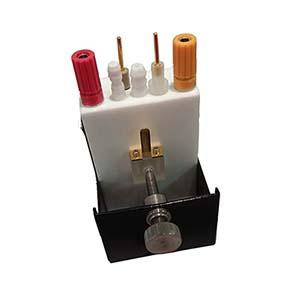
C012-2 All-Quartz Spectroelectrochemical Cell

- PRODUCT DETAIL
C012-2 All-Quartz Spectroelectrochemical Cell
Product Introduction
The
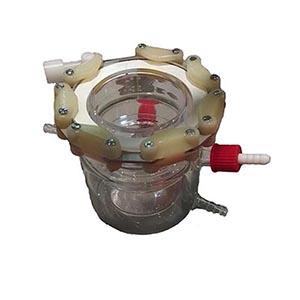
C012-2 All-Quartz Spectroelectrochemical Cell is a sealed quartz
electrochemical cell designed for spectroelectrochemical experiments requiring
high optical transparency and a sealed cell structure. Developed from the
C012-1 model, it features an additional sealing cover to improve the sealing
performance of the cell body.
Manufactured
from high-transmittance quartz, the cell offers light transmittance of at least
95%. Its one-piece polished construction eliminates adhesive joints, providing
an integrated cell body suitable for demanding laboratory applications. The
PTFE lid supports customizable round or square openings, while optional
sand-core salt bridges or Luggin capillary salt bridges provide flexible
electrode configurations.
Performance Features
• Sealed cell design: An additional sealing cover improves the
sealing performance compared with the C012-1 open-cell design.
• High optical transmittance: Quartz
construction provides light transmittance of at least 95%.
• One-piece polished construction: The cell
body is polished as an integrated component rather than assembled by gluing.
• High-temperature resistance: The quartz cell body can withstand
temperatures up to 900°C.
• Customizable PTFE lid: The lid can be configured with round or square
openings according to experimental requirements.
• Optional salt bridges: A sand-core
salt bridge or Luggin capillary salt bridge can be added for different
electrochemical setups.
Working Principle
The
C012-2 provides a sealed environment for electrochemical measurements combined
with optical observation or spectroscopic analysis. Light passes through the
high-transmittance quartz cell body, allowing optical signals to be collected
during electrochemical experiments.
Electrodes
and optional salt bridges can be arranged through the customized openings in
the PTFE lid. The sealing cover helps improve the enclosure of the cell,
supporting experiments that require a more controlled cell environment.
Technical Parameters
Parameter
Specification
Model
C012-2
Product
Type
All-quartz
spectroelectrochemical cell
Cell
Body Material
High-transmittance
quartz
Light
Transmittance
≥95%
Construction
One-piece
polished construction, not glued
Maximum
Temperature
900°C
(cell body)
Lid
Material
PTFE
Lid
Opening Options
Customizable
round or square holes
Sealing
Design
Sealing
cover
Optional
Accessories
Sand-core
salt bridge or Luggin capillary salt bridge
Application Scenarios
• Spectroelectrochemical research: Electrochemical experiments combined
with optical or spectroscopic measurements.
• Electrode and material studies: Investigation of electrochemical behavior and material properties under
controlled cell conditions.
• Electrochemical interface research: Experiments
requiring optical access to the electrolyte and electrode system.
• Laboratory electrochemical testing: Applications that benefit from a sealed quartz cell and customizable electrode
arrangements.
Comparison: C012-1 vs. C012-2
Feature
C012-1
C012-2
Cell
Body Material
High-transmittance
quartz
High-transmittance
quartz
Light
Transmittance
≥95%*
≥95%
Construction
One-piece
polished construction
One-piece
polished construction
Cell
Design
Open
cell
Sealed
cell with additional cover
Lid
PTFE
lid
PTFE
sealing lid
Customizable
Openings
Round
or square
Round
or square
Optional
Salt Bridge
Sand-core
or Luggin capillary
Sand-core
or Luggin capillary
Maximum
Cell Body Temperature
900°C
900°C
The C012-1 comparison is based on its previously supplied
product specifications. Confirm the detailed configuration and sealing
performance with the manufacturer before selection.
Frequently Asked Questions
1. What is the main difference between the C012-1 and
C012-2 spectroelectrochemical cells?
The
main difference is the sealing design. The C012-2 adds a sealing cover to the
cell body, improving sealing performance compared with the open-cell C012-1.
2. What material is used for the C012-2 cell body?
The
cell body is made of high-transmittance quartz, with a specified light
transmittance of at least 95%.
3. Is the C012-2 cell body glued together?
No.
The quartz cell body uses one-piece polished construction rather than adhesive
bonding.
4. What is the maximum temperature the C012-2 can
withstand?
The
quartz cell body can withstand temperatures up to 900°C. The PTFE lid must be
separated from the cell body during heating or sterilization.
5. Can the PTFE lid be customized?
Yes.
The lid can be manufactured with round or square openings according to the
user's experimental requirements.
6. Can a salt bridge be installed in the C012-2 cell?
Yes.
Optional configurations include a sand-core salt bridge and a Luggin capillary
salt bridge.
7. What experiments is the C012-2 suitable for?
It
is suitable for spectroelectrochemical research and other electrochemical
experiments requiring high optical transmittance, a quartz cell body, and an
improved sealed configuration.

NEXT:C013-1 Open All-Quartz Photoelectrochemical Cell